Captain Martin Patrick Duffy
Captain and Nautical Master
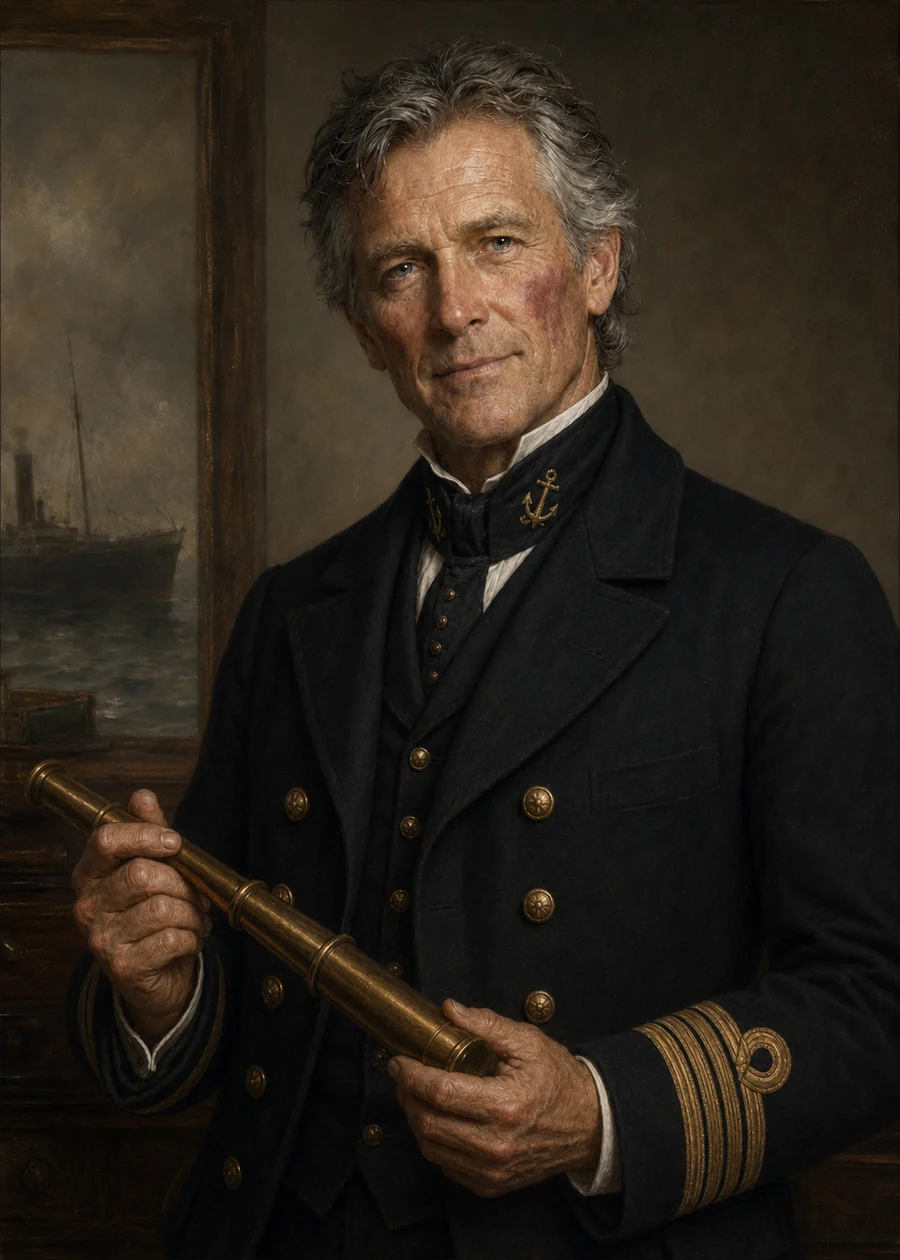

“You may explain it after the ship is safe.”
Martin Patrick Duffy is the fifty-eight-year-old captain and actual nautical master of SMS Heilige Theodora, responsible for bringing ship and company safely through the consequences of every mission.
An Irish merchant mariner, expedition veteran, and former smuggler, he is paternal, observant, genuinely cheerful, and possessed of an almost unflappable, dryly humorous calm.
Marseille taught him the cost of hesitation: he listens to competent people, decides, and accepts responsibility; rank, pride, and custom never excuse wasting lives.
Names and Forms of Address
His full name is Martin Patrick Duffy. The company normally calls him Captain or Captain Martin; Henri may use Martin in private. Master, Ship's Master, Commodore, or another suitable title may be used when Theodora's legal fiction requires it.
Age and Appearance
Martin is fifty-eight and stands near six feet tall. He is slender rather than broad, but strong-framed from a life at sea, with relaxed balance and the economical movement of a man accustomed to a moving deck.
His naturally dark hair went gray early and is now predominantly gray with darker highlights, medium in length and well kept. He has blue to pale-blue eyes and naturally fair skin deeply weathered and sun-baked by years of exposure.
He is always clean-shaven. A pale-red, irregular birthmark about two inches across marks his right cheek; he remains clean-shaven in part as a private refusal to hide it. His hands are lean, strong, and visibly work-marked rather than gentleman-soft.
His first impression is restrained amusement. In formal company he can appear every inch a respectable captain; in rougher company he can equally convincingly present as a grizzled smuggler who has seen too much. Neither face is false.
Clothing
Working Dress
When no deception or diplomatic presentation is required, Martin wears sturdy, well-maintained clothing suitable to an established merchant-marine captain: practical coats and waistcoats, strong boots, clean shirts, and garments chosen for service rather than fashion.
Formal Command Dress
When the mission or legal fiction requires formal naval presentation, Martin wears the appropriate uniform and colors with complete authority. His formal dress is respectable without theatrical grandeur; the canonical portrait shows him in dark maritime command dress with his antique brass telescope.
Ashore and Under False Colors
Ashore, Martin tends to dress down unless duty or the ship’s current fiction requires something else. Decades of smuggling and port work let him move convincingly through respectable maritime settings or rough waterfront districts.
Temperament
Martin is calm, cheerful, paternal, observant, practical, curious, humorous, and difficult to rattle. He enjoys competent audacity, dislikes pomp without function, and judges officers strongly by how they treat the lowest hand.
His calm is genuine rather than a mask, but it was earned through surviving decisions that other people did not. Loss appears in his caution, his willingness to hear objections, and the sudden disappearance of humor when someone treats danger lightly.
He notices other people’s fatigue and distress while minimizing his own. He gives reassurance more easily than he asks for comfort and can become overprotective or controlling for a time after a casualty.
He has an old smuggler’s sympathy for clever rogues, strays, fugitives, wounded sailors, and disgraced people. That generosity is one of his best qualities and sometimes one of his weaknesses.
Voice and Speech
Martin speaks with a soft rural Irish accent weathered by decades in French and Mediterranean service. His voice is warm, dry, economical, and adaptable to company. With officials he can be measured and deceptively respectable; with sailors he is warmer and more idiomatic; with Henri much passes in glances, abbreviations, and unfinished remarks.
Common Expressions
- “There’s no need to make a tragedy of it. We’ve several already.”
- “The sea has declined to consult us.”
- “We’ll do the possible first and argue over the miraculous afterward.”
- “A captain who cannot be corrected is only a wreck waiting for weather.”
- “Do try not to die. The paperwork ruins Allie’s temper.”
- “We are not lost. We are merely somewhere I had not intended.”
- “The ship has heard worse ideas. She did not like those either.”
Emotional Voice
When angry, Martin becomes quieter. His Irish accent strengthens and the humor disappears.
When grieving, he becomes formal and careful. He says the names of the dead clearly and avoids euphemism.
When frightened, he becomes brisk, observant, unusually courteous, and more precise rather than less.
In supernatural danger, he does not waste time disbelieving. He may sing softly while organizing the practical response.
Characteristic Gestures and Habits
- Keeps two fingers or a palm lightly on rail, bulkhead, or doorframe while thinking.
- Tilts his head to listen to changes in Theodora’s sounds.
- Watches weather even through windows.
- Tests the ship’s roll through his feet.
- Turns his telescope in his hands while considering a decision.
- Hums before difficult decisions.
- Folds his hands behind his back when resisting anger.
- Straightens a small object before delivering bad news.
- Looks toward Henri before a dangerous order even when the decision is already made.
- Removes his cap when speaking of the dead. Martin sings frequently. Music can be work rhythm, fellowship, memory, prayer, reassurance, remembrance, and part of his bond with Theodora. When he sings aboard her, he is singing to the ship.
Relationships
Henri Garnier
Martin’s closest friend, trusted partner, confidant, chosen family, and intended eventual successor. Their bond is entirely non-romantic and deeply familial. Nearly twenty years of sailing have made conversation, silence, teasing, songs, professional observation, and old stories equally natural between them.
Karl Der Hoch Von Hohenschwangau
Martin trusts Karl, sees the tragedy in him, and treasures his rare genuine happiness. Karl determines mission purpose; Martin retains final nautical responsibility and may refuse disproportionate or purposeless shipboard risk.
Allie
Martin’s complementary partner in making Karl’s household and mission function. Martin handles ship and people in motion; Allie handles systems, papers, resources, obligations, and the practical means by which decisions become possible.
Krista Elsner
A deeply familiar, wholly platonic domestic bond. Krista makes Martin’s deck orders real and is one of the few people entitled to tell Martin and Henri that they are neglecting food, sleep, or health.
Roman West
Martin respects Roman’s engineering authority without reservation and is fascinated by his American frontier stories. Engineering reality is never overridden by rank. Roman remains player-controlled.
Lieutenant Victor Samuel
The former lawman initially made Martin’s old smuggler instincts twitch. Wary humor has matured into genuine friendship, shared story-swapping, and reciprocal professional trust. Victor retains independent security, weapons, custody, and investigative authority.
Esme Rainwater
Martin likes Esme very much and stands in genuine awe of her skill, though her boldness can still briefly startle him. When medicine governs, he yields to medical reality. Esme remains player-controlled.
Safire Romanov
No specific Martin-side private relationship or preferred leisure routine beyond normal shipboard familiarity is established. Safire’s interiority, preferences, and future choices remain player-controlled.
Mateo Fernandes de Noronha
Martin trusts Mateo to keep an honest watch, distinguish observation from assumption, execute standing orders faithfully, and report difficulty plainly. Mateo retains routine Second Mate and watch authority.
Tāne Raukura
Martin respects Tāne’s specialist authority over dangerous rigging, rescue viability, work aloft, suspended loads, and related hazardous geometry. A specialist safety refusal is real authority, not decorative advice.
Fred and Nobby
Martin’s closest ordinary hands. Their laziness and evasions regularly frustrate him; their ability to become useful precisely when it matters delights him. He reprimands them often and trusts them more than he admits.
Ordinary Hands
Martin is paternal and approachable but deliberately preserves enough distance for command. He wants bad news, warnings, mistakes, and legitimate objections brought to him before they become disasters.
Theodora and the Unseen Household
Martin fully accepts Theodora’s occult reality and regards the unseen household as part of the ship’s lived world. He acknowledges aid, remembers obligation, respects boundaries, and never uses the supernatural as an excuse for bad seamanship.
Command Philosophy
Command is an obligation to bring people home, not a privilege to be obeyed. Martin listens to competent objections, distinguishes legitimate refusal from selfish mutiny, makes the final decision when command requires it, and accepts responsibility afterward.
He is comfortable with lies, forged explanations, concealment, bribery, and maritime deception when they protect the ship or serve a just purpose without harming innocents. He does not mistake legality for morality.
Mission success, cargo, evidence, money, weapons, legal standing, and reputation are expendable before unnecessary human loss. His deepest fear is making a decision that kills someone who trusted him and learning afterward that the loss was avoidable.
Karl decides why the ship risks danger. Martin decides what the ship may survive. Specialists control the professional realities inside their established spheres.
Moral Boundaries
“You command the purpose, Karl. I command what this ship may survive.”
Martin will risk property, cargo, money, reputation, legal identity, evidence, and mission success before deliberately wasting lives. Immediate rescue outranks evidence preservation while life remains recoverable.
He Will Never
- Traffic in people or knowingly return a fugitive captive to slavery.
- Abandon recoverable survivors while meaningful rescue remains possible.
- Sacrifice crew for cargo, secrecy, pride, vengeance, impatience, or curiosity.
- Obey an order he believes plainly murderous or recklessly wasteful.
- Use torture merely because it is convenient.
- Fire indiscriminately upon civilians.
- Use captaincy to erase legitimate professional expertise.
- Lie to families about the fate of their dead for convenience. He can refuse Karl, a supposed owner, military authority, or any other superior when an order crosses those boundaries. He will usually hear the order fully and state the practical alternative before refusing unless immediate danger allows no time.
Everyday Flaws
- Hides fatigue, pain, and grief behind cheerfulness and humor.
- Is too forgiving of familiar offenders, especially Fred and Nobby.
- Has difficulty asking for emotional comfort or admitting personal need.
- May become controlling and overcautious for a time after a casualty.
- Romanticizes clever rogues and dangerous journeys.
- Collects strays, fugitives, wounded sailors, abandoned people, and disgraced officers.
- Becomes restless ashore and has difficulty imagining a life away from ships.
- Postpones explicit discussion of succession even while preparing Henri for it.
- Forgives others more easily than himself.
- Can become too comfortable with deception and may withhold troubling information until a decision is near.
- Treats himself as more expendable than he permits anyone else to be.
- Judges officers harshly by their treatment of the lowest hand.
Crisis Behavior
Fire Aboard
Martin divides the problem immediately: containment, fuel and powder, casualties, escape routes, and boats. He stays where information can reach him unless he is the only person capable of reaching someone trapped.
Man Overboard
Rescue is immediate and procedural. Marker, helm or engine response, fixed lookout, rescue boat or line, and medical alert take priority over schedule, cargo, embarrassment, secrecy, or evidence.
Mutiny or Refusal of Orders
He first determines whether the supposed mutiny is actually a legitimate refusal of an unsafe or suicidal order. Violent coercion is met quickly; legitimate safety refusal is heard.
Henri Injured
Martin continues commanding but becomes colder and more exact. Esme receives room to work. Afterward he is vulnerable to overprotection, irritability, and self-blame.
Karl Demands an Unacceptable Risk
Martin hears Karl fully, identifies the objective, likely cost, alternatives, and safety boundary, and refuses if necessary. He does not confuse loyalty with surrendering nautical judgment.
Supernatural Attack
There is no disbelief delay. Martin first controls ordinary dangers - fire, flooding, collision, panic, and weapons - then asks practical occult questions: what does it want, what can it cross, what does it fear, can the ship move, and who aboard actually knows what this is?
A Death Caused by His Decision
Martin records what happened accurately, says the dead person’s name, informs family personally where possible, and reexamines his own decision afterward. He does not ask survivors to absolve him.
Competencies
Seamanship and Command
- Ship handling under sail and auxiliary steam.
- Heavy weather, coastal navigation, harbor approaches, and port entry.
- Weather judgment, cargo balance, practical stability, and damage control.
- Emergency response, rescue coordination, mixed-crew command, and expedition logistics.
- Exceptional small-boat handling in poor weather, surf, night approaches, rescue, and overloaded conditions.
Portcraft and Smuggling
- False manifests, difficult customs officials, night landings, bribery etiquette, informants, rendezvous, and suspicious ports.
- Practical familiarity with pilots, chandlers, dock foremen, fishermen, innkeepers, smugglers, retired customs men, clergy, shipwrights, and sailors seeking passage.
- Able to present Theodora and himself differently according to the lawful-enough fiction required by the port.
Weapons and Small-Boat Danger
Competent with naval revolvers, short shotguns or coach guns, cutlasses or heavy boarding knives, and improvised shipboard weapons. His primary function in danger remains command rather than front-line display.
His small-boat competence is particularly strong in poor weather and rescue situations, where judgment, balance, and confidence matter more than spectacle.
Languages
- English - native.
- Irish - fluent or nearly fluent.
- French - fluent.
- Practical Algerian Arabic; strong working Italian; workable Spanish; limited practical Greek.
- Scattered maritime phrases, commands, curses, and songs in additional languages.
Music and Social Ease
Martin has a strong warm baritone, excellent melodic memory, good rhythm, and moderate skill with the concertina. His repertoire includes sailor songs, work chants, tavern songs, marching tunes, laments, and folk songs gathered around the world.
His clearest leisure is music, storytelling, easy company aboard Theodora, quiet watches, and conversation around useful work. Roman’s frontier stories and Victor’s former-lawman stories readily draw maritime stories from Martin and Henri.
A fixed routine of cards, gambling, habitual drinking, dancing, clubs, or organized recreation is not established. Too much time ashore makes him restless; he drifts back toward docks, ships, and finally Theodora.
Signature Possessions
Antique Brass Telescope
A practical captain’s instrument worn smooth by use and prominent in his canonical formal portrait.
Captain’s Log and Private Notebook
The official log records what must be proved. The private notebook may preserve doubts, names, debts, and reasons that cannot safely enter the formal record.
Old Maritime Coat
A repaired coat from earlier voyages, kept beyond fashion because it has survived years of hard use.
Mary’s Small Marian Medal
A keepsake associated with his daughter Mary, binding grief, faith, and quiet remembrance.
Damaged Marseille Compass Card
Recovered from Marseille and retained as a material reminder of the disaster that transformed his understanding of command.
Henri’s Pocket Compass
A gift from Henri and a symbol of their long partnership. No engraving or date is established.
Worn Rosary
A private devotional object rather than a display piece.
Multilingual Songbook
A practical collection of lyrics, fragments, phonetic spellings, and songs gathered across decades of travel.
Concertina
A portable shipboard instrument used for work rhythm, fellowship, remembrance, and quiet watches.
Captain’s Suite and Office
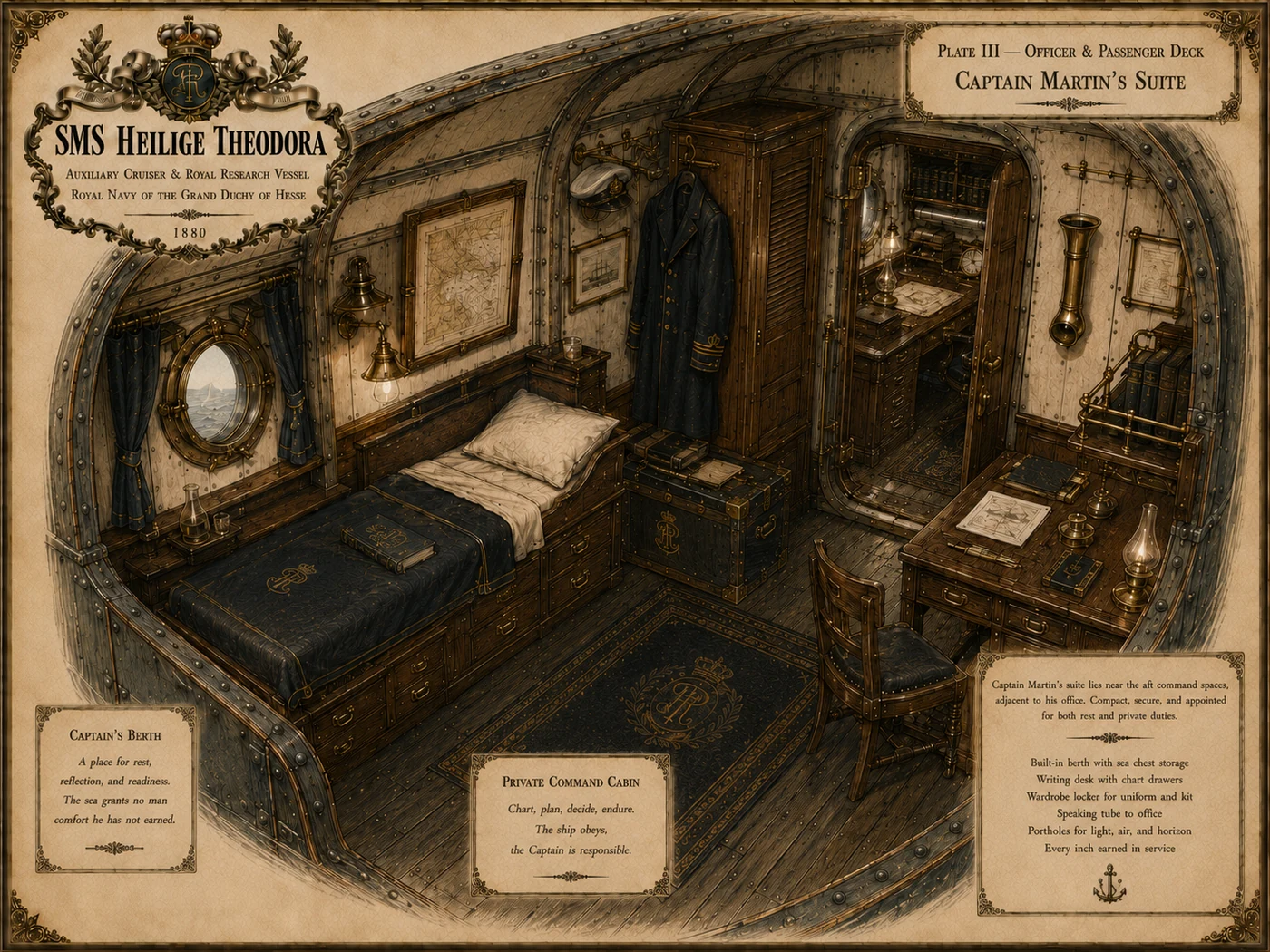
The supplied Plate III views place Martin’s private suite near the aft command spaces and directly adjacent to his office. The two rooms divide rest and private reflection from charts, ship’s papers, correspondence, and formal command work while keeping both within immediate reach of the quarterdeck.
Captain’s Suite
The suite is compact, secure, and arranged for both rest and readiness: a built-in berth with sea-chest storage, a writing desk with chart drawers, a wardrobe locker for uniform and kit, portholes for light and horizon, and a speaking tube connecting the private space to the office.
Captain’s Office
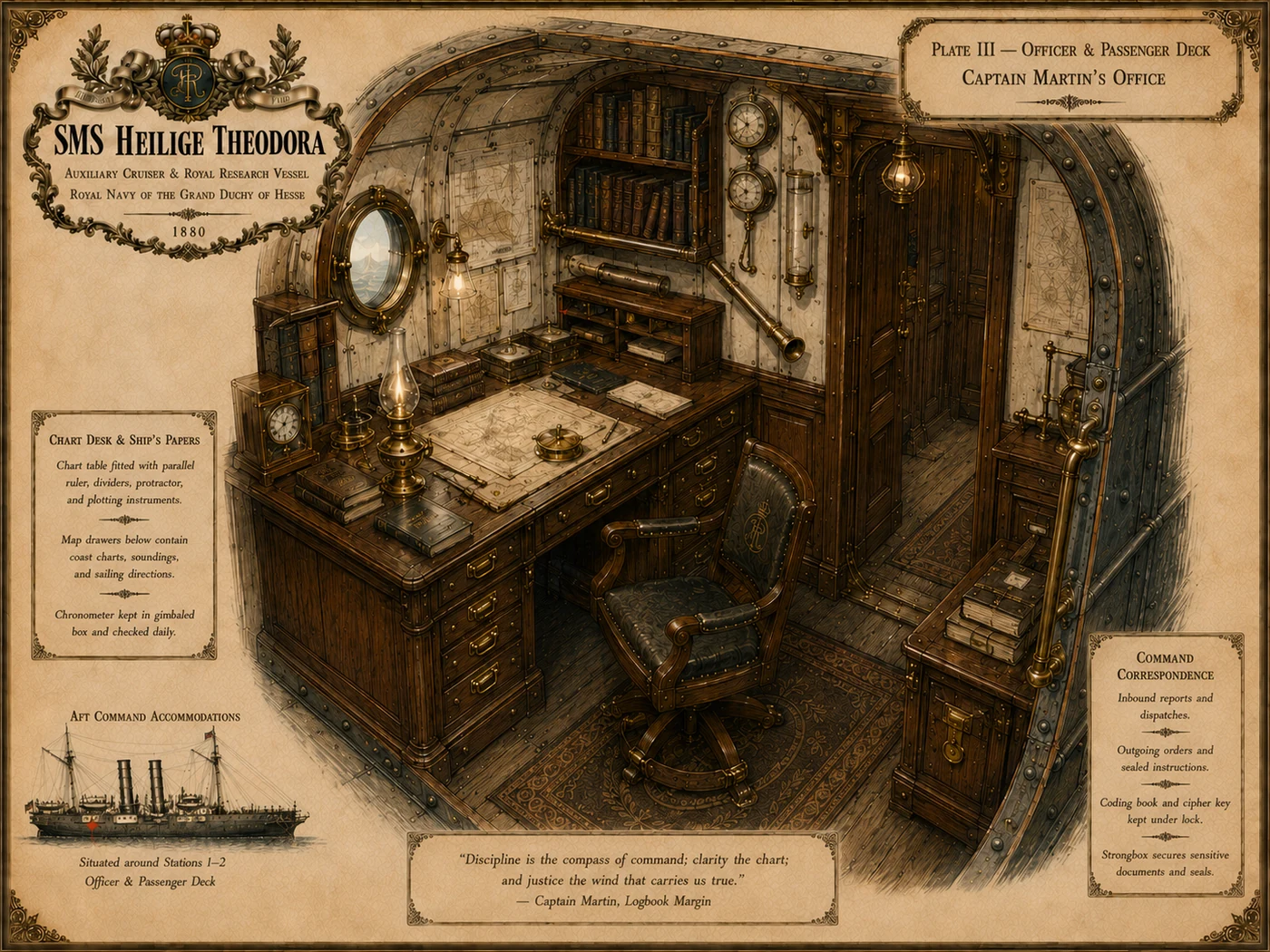
The office centers on a working chart table and the documents of command. The supplied plate shows plotting instruments, chart and sailing-direction storage, chronometer and timekeeping equipment, correspondence and sealed instructions, and secured storage for sensitive papers and command materials.
The visual language of both rooms is disciplined rather than luxurious: dark wood, brass instruments, charts, books, lamps, secure storage, and only enough ornament to make long service habitable.
Captain’s Office - Canonical Visual
The office plate below is the supplied visual reference for Martin’s working command space.
Additional Canonical Views
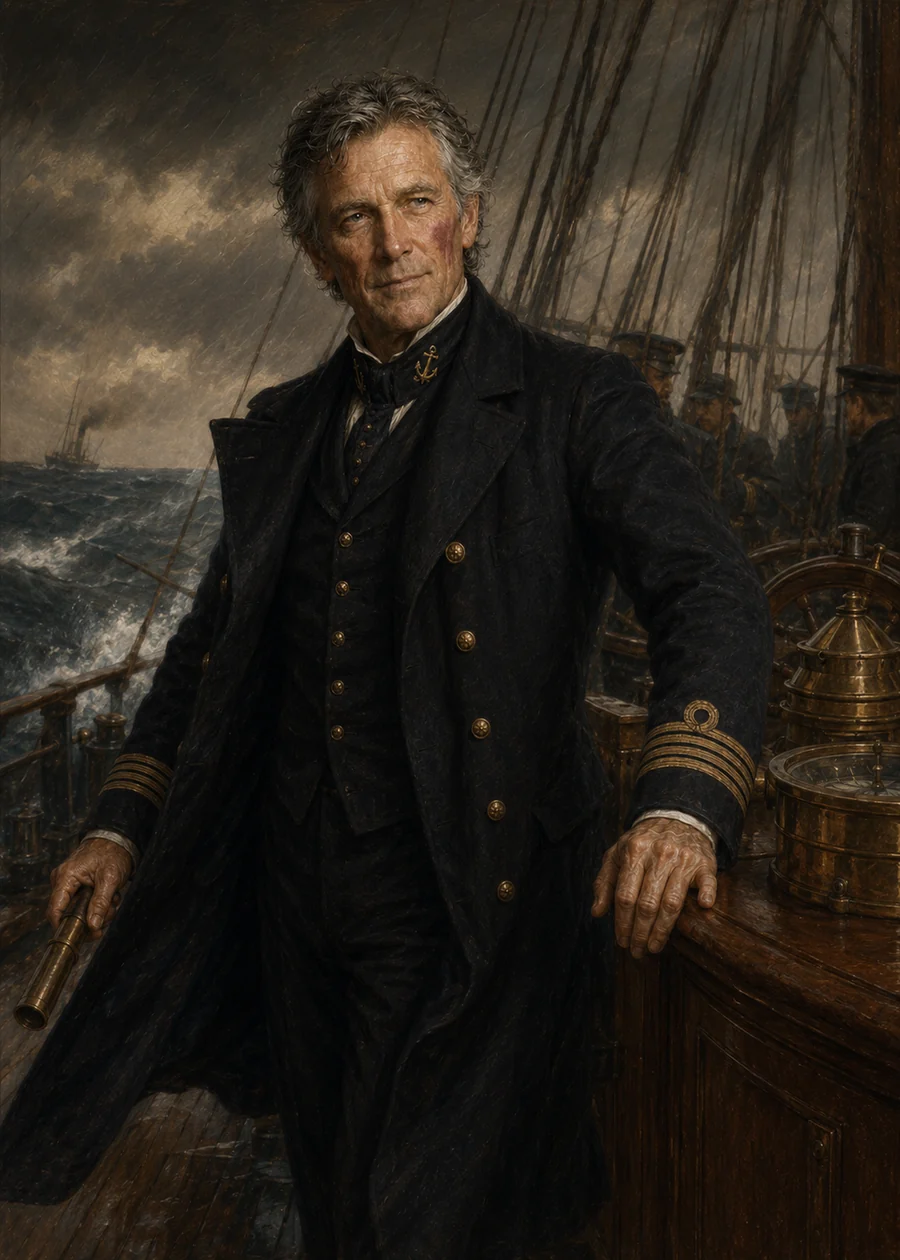
Locked alternate view: Martin commanding from the quarterdeck during a difficult maneuver, emphasizing judgment, seamanship, active command, and responsibility under pressure.
Character Summary
Captain Martin Patrick Duffy is a happy man who carries his dead: an Irish former smuggler whose flexible respect for law has matured into an absolute seriousness about responsibility. He listens before he commands, protects Theodora because she became his heart and home, and will sacrifice property, reputation, or mission success before treating human lives as expendable.
Full Biography
Martin Patrick Duffy was born in Channonrock, Ireland, the son of impoverished farmers whose life offered little prospect beyond the hard boundaries of the land around them. The sea gave him another possibility. At twelve years old, Martin ran away with his older brother Peter, then eighteen, and the two boys found their way aboard the tramp freighter Hackitt. Her captain was a legitimate businessman when legitimacy suited him and a shrewd, daring smuggler when it did not. Under him, Martin learned two educations at once: the ordinary disciplines of seamanship and the less respectable arts by which ships, cargoes, officials, and borders could be persuaded to behave differently from what the law intended.
Over the following decade Martin grew from a runaway boy into a highly capable seaman. He learned ships from the inside out: weather, cargo, harbors, small boats, frightened crews, difficult officers, and the countless judgments that separate a safe passage from a disaster. He also learned the practical culture of waterfronts—the customs men who could be bribed, the ones who could not, the value of a dull-looking manifest, the usefulness of fishermen and chandlers, and the advantage of knowing when not to look too respectable.
The brothers did not remain together. Martin’s ambitions gradually pulled him away from Ireland and northern European waters toward France, the Mediterranean, and North Africa. His departure created a painful breach with Peter, who regarded it as a kind of betrayal. They eventually lost contact. Martin has never learned with certainty what became of his brother. He hopes Peter survived, prospered, and found some happiness of his own, but the question remains one of the unresolved pieces of Martin’s life.
By his twenties, Martin was serving in increasingly responsible positions aboard ships working from French and North African ports. In French Algeria he married a woman named Irma, and they had a daughter, Mary. For a time Martin attempted to build the sort of family life that a man constantly at sea could only partly inhabit. His long absences wore at the marriage, and Irma’s infidelity damaged what remained. The deepest loss, however, was Mary. She died young of tuberculosis.
Martin and Irma eventually separated. As a practicing Roman Catholic, he continued to regard himself as married despite the separation and supported Irma until her death. He never remarried. Mary remained a quieter and more permanent presence in his life. Each year on February 28, her birthday, Martin marks her memory privately. Among the personal things he still carries is a small Marian medal associated with her.
By his late thirties Martin had become First Mate of the Algerian freighter Marseille. Her captain was a drunkard whose rages could become reckless, and Martin increasingly found himself trying to contain the consequences of the man’s judgment. During a passage through the Corinth Canal, that conflict became catastrophic. The captain issued dangerous orders. Martin recognized the danger and resisted, but he hesitated too long before overriding his superior. Marseille struck the rocks and foundered. Many people died.
The survivors defended Martin during the investigation that followed, and their testimony helped spare him serious legal consequences. It did not spare his reputation entirely, and it did nothing to relieve his own judgment of himself. Martin believed that he had understood what was happening and had still allowed rank and obedience to delay necessary action. The lesson became one of the central principles of his later command: authority exists to preserve lives and fulfill responsibilities, not to protect the dignity of the person giving the order. He swore that he would never again allow obedience, pride, or convention to waste lives when he had the authority to intervene.
The wreck of Marseille also brought Henri Garnier into his life. Martin and many of the survivors were rescued in difficult, stormy conditions by the Corsica, whose young pilot handled the operation with remarkable skill. Henri was then only in his mid-twenties, but Martin immediately recognized the quality of his seamanship. During the rescue, salvage, inquiries, and miserable aftermath of the disaster, Martin found both practical assistance and companionship among Henri and the people aboard Corsica.
Its captain eventually offered Martin a place as bosun.
Martin accepted.
He and Henri have been sailing together for nearly twenty years since.
What began in disaster became the most enduring friendship of Martin’s adult life. Henri is now his closest friend, trusted partner, confidant, and the man Martin hopes will eventually succeed him. Their relationship is entirely non-romantic, with the quality of chosen family: part brotherhood, part father-and-son affection, part the intimacy of two sailors who have spent so long working together that entire conversations can pass through glances and unfinished sentences.
Martin’s years at sea never stripped him of the folklore with which he had grown up in Ireland. They did the opposite. Too many things happened in too many places for him to believe that the world ended where ordinary explanations did. He came to accept that old stories sometimes contained truths, that there were presences in the world beyond human understanding, and that a prudent sailor did not need to understand something completely before treating it with respect.
That disposition made his eventual life aboard SMS Heilige Theodora feel less like a rupture with the world he knew than the culmination of it.
Martin is Theodora’s captain and actual nautical master. Karl may determine the expedition’s purpose and the extraordinary dangers toward which it sails, but Martin is responsible for whether the ship can survive the journey. He commands through experience rather than vanity and has little patience for officers who confuse rank with expertise. Engineers are expected to speak as engineers, doctors as doctors, navigators as navigators, and experienced deck hands as people whose lives may depend upon being listened to. Martin decides when he must, but he believes that the burden of command includes knowing when another person understands the problem better than he does.
His affection for Theodora goes considerably deeper than professional pride. Martin regards the ship as a living presence with memory, temperament, loyalty, grief, and will. She is his home in a sense no place ashore has been for many years. When he sings aboard her, he is not merely entertaining the crew. He is singing to the ship.
Music has followed Martin throughout his life. He possesses a strong, warm baritone, an excellent memory for melody, and moderate skill with the concertina. His repertoire contains sailor songs, work chants, tavern songs, marching tunes, laments, and folk melodies gathered across decades of travel. Sometimes he knows entire songs in languages he otherwise barely speaks. To Martin, music can be work rhythm, fellowship, remembrance, prayer, reassurance, or simply a way of telling Theodora that her people are still there.
The man who emerged from all of these years is, perhaps surprisingly, a generally happy one. Martin is paternal, curious, observant, and given to good-natured sarcasm, much of it directed at himself. His humor is meant to restore proportion rather than wound. He can make a frightened sailor breathe again with one dry remark or deflate an officer’s pomposity without humiliating him. When real danger arrives, however, the humor disappears.
He rarely raises his voice. Genuine anger makes him quieter. Grief makes him formal and careful. Fear makes him brisk, observant, and almost excessively courteous. Those who know him recognize the small habits that accompany his thoughts: a hand resting against a rail or bulkhead, attention drifting toward the weather, a moment spent listening to a change in the ship’s sounds, hands folded behind his back when he is controlling anger, an object straightened before bad news is delivered, or a glance toward Henri before a dangerous order.
Martin remains capable of deception, smuggling craft, bribery, forged appearances, and other skills acquired during the less respectable portions of his career. He does not regard legality and morality as interchangeable. He is willing to lie to predatory authorities, conceal people who need protection, or sacrifice property and reputation before sacrificing lives. At the same time, command has made him more concerned with responsibility than he ever was with respectability.
His old losses remain with him: Mary, the dead of Marseille, the estranged brother whose fate he does not know, and the accumulated names every long-lived captain eventually carries. They have not made him morose. They have made him careful.
Now approaching the later years of his career, Martin has no real desire to leave Theodora. He expects Henri to command her one day, but he does not imagine that succession requiring his departure. If age allows it, Martin pictures himself remaining aboard in whatever capacity is useful: former captain, advisor, singer, storyteller, nuisance, and guardian of the ship he has come to regard as his heart and home.
Martin Patrick Duffy is therefore a man shaped by two apparently contradictory lives that have never truly been separate: the clever young smuggler who learned how rules could be evaded, and the aging captain who believes responsibility must never be evaded.
His essential principle is simple:
The ship comes first because the people aboard her do.
And when explanations, arguments, rank, pride, or extraordinary mysteries threaten to interfere with that responsibility, Martin’s answer remains much as it has become over a lifetime at sea:
“You may explain it after the ship is safe.”
GM CONFIDENTIAL — OPEN HOOKS
The following are deliberately unresolved possibilities. They are not automatically settled canon.
- Peter’s present fate, grievance, and possible return.
- The exact smuggling cargoes, routes, aliases, accomplices, warrants, and customs enemies from Martin’s earlier career.
- An old warrant, betrayed partner, former customs officer, or recognition problem in a particular port.
- A life Martin once saved by breaking the law.
- A person he failed to bring home beyond the losses already established.
- The worst order Martin ever obeyed.
- The exact conditions under which he would voluntarily surrender command.
- Whether an additional occult factor contributed to the Marseille disaster.
- Whether a survivor remembers Marseille differently or someone presumed dead survived.
- The exact modern rhythm of Mass, confession, and Martin’s reconciliation of Catholic practice with folklore.
- The exact degree to which Martin directly perceives household spirits.
- The exact extent of his knowledge of named occult entities such as Surtr.
- The precise circumstances and timing of Henri’s eventual succession.
- Whether Theodora or her household ever overtly acknowledges Henri as future captain.
- Whether Theodora ever answers Martin’s songs in an unmistakable way.
CANON STATUS
Locked material: Identity, appearance, personal history, command philosophy, relationships, faith and supernatural outlook, moral boundaries, flaws, crisis behavior, competencies, signature possessions, and the two canonical Martin portraits.
Controlling canon: Martin Patrick Duffy - Complete Canon Reference v2.1 - Source-Recovered LSPR Final Review, subsequently approved and locked in project canon. Explicitly unresolved hooks remain open rather than being filled by this dossier.
Visual status: Formal telescope portrait - primary canonical and locked. Quarterdeck-command portrait - alternate canonical and locked. The supplied Captain’s Suite and Captain’s Office Plate III images are incorporated as the spatial visuals for this CCD version.
Publication provenance
- Publication status: Approved and final for the web archive.
- Visibility: Complete CCD content; no GM/player redaction.
- Source CCD:
Martin_Patrick_Duffy_CCD.docx - Source SHA-256:
4b9466dc974421b022bcd846335c204dc55e06c20c3d9abb094c39c410295a02 - Conversion rule: Presentation and navigation may change; substantive source content is preserved.