Kobina Teah
Ship’s Carpenter
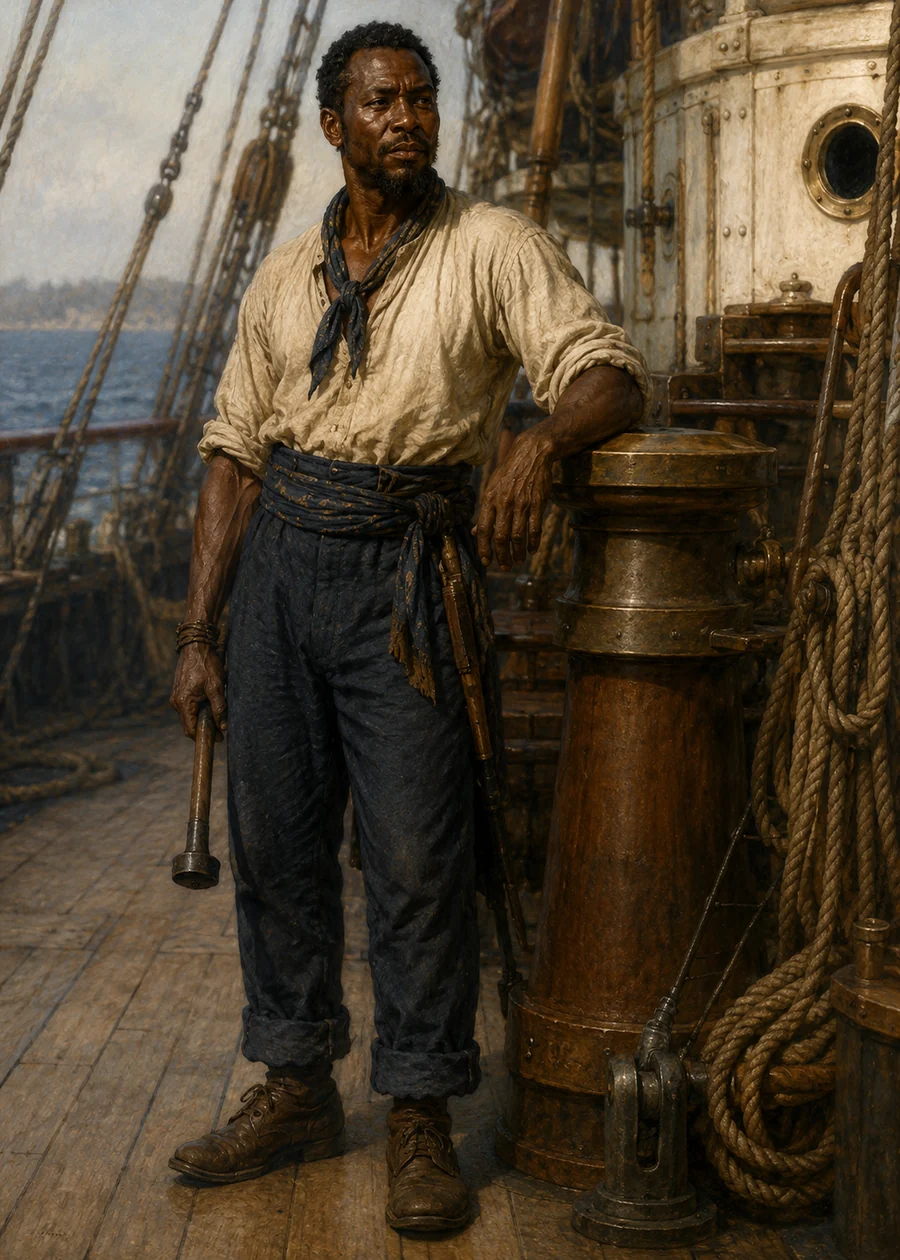

“The wood warned you before it broke. You did not listen.”
Kobina Teah is 46 and serves as Ship’s Carpenter aboard SMS Heilige Theodora. A man who turns grief into workmanship, discipline, and protection..
The Teah family comes from a Kru coastal community in what Europeans presently call Liberia. Seamanship is a family inheritance, a professional identity, and a source of independence.
Aboard ship, Kobina occupies a defined working place in the family’s shared responsibility for the vessel. Inspect hull timbers and internal framing; Maintain decks, hatches, bulkheads, ladders, and boats.
Names and Forms of Address
Full name: Kobina Teah. Ordinary address uses Kobina. Established role: Ship’s Carpenter. No additional form of address is required by the controlling master.
Age and Appearance
Kobina Teah is 46 years old. Height: approximately 5 feet 9 inches; Build: heavy, powerful, thick through the shoulders and chest; Complexion: deep brown, weathered by sun and salt; Hair: close-cropped black hair, beginning to gray at the temples.
Eyes: dark brown, steady and difficult to read; Face: broad, with a strong jaw and deep lines around the mouth; Hands: heavily calloused, scarred, and exceptionally strong; Distinguishing marks:.
He and Kwesi are unmistakably twins when seen together, but Kobina appears heavier, sterner, and more rooted.
Clothing
Working Dress
At work: In cold weather: Heavy canvas or wool trousers; Collarless work shirt; Dark waistcoat with reinforced pockets; Leather tool belt; Stout boots; Protective apron during major carpentry; Rolled sleeves unless formal inspection is underway.
Formal / Special-Occasion Dress
One carefully maintained formal coat is established; he dislikes wearing it.
Temperament
Quiet; Exacting; Protective; Patient with sincere effort; Impatient with carelessness.
Slow to forgive deliberate negligence; Uncomfortable with emotional display; Capable of dry, devastating humor; More compassionate than he allows strangers to see.
He rarely raises his voice. When Kobina becomes quieter than usual, the crew knows a serious correction is coming.
Voice and Speech
Low and deliberate; Uses few unnecessary words; Does not repeat instructions unless circumstances genuinely require it; Often frames judgments in terms of structure, weight, grain, or strain; Speaks more freely in the family language; Uses names sparingly, making them significant when he does.
Common Expressions
- “The wood warned you before it broke. You did not listen.”
- “Strong is not the same as sound.”
- “Do it again. This time, do not make the ship pay for your impatience.”
- “A repair is a promise. Make only the promise you can keep.”
Emotional Voice
When angry, he becomes quieter and more exact rather than louder.
Under pressure, his speech stays spare and structural: weight, strain, sequence, and safety.
Grief is more likely to appear as work, silence, sharpening tools, or practical protection than as display.
Characteristic Gestures and Habits
- Touches a bulkhead when entering an unfamiliar part of the ship
- Sharpens tools when troubled
- Inspects Siah’s hands for injuries without comment
- Sleeps lightly during bad weather
- Keeps broken parts until he understands why they failed
- Never sits on a workbench
- Hums very quietly when doing precise work These habits are observable cues, not exhaustive private psychology.
Relationships
Kwesi
His twin and closest equal. Kobina sometimes believes Kwesi speaks too lightly about serious matters; Kwesi believes Kobina mistakes silence for endurance. Their disagreements are sharp but rarely last.
Siah
Kobina loves his son deeply but teaches him with severe standards. He fears praise will make Siah careless and does not realize how strongly Siah longs for his explicit approval.
Tamba
He appreciates Tamba’s agility and good humor but watches for signs of recklessness. Tamba can sometimes draw a reluctant smile from him.
Kofi
Kobina is gentler with Kofi than with the older boys. He pretends not to notice when the child enters the workshop merely to remain nearby.
Martin
Strong professional respect. Kobina trusts Martin because the captain does not ignore warnings about the ship for the sake of pride.
Henri
Kobina respects Henri’s judgment but dislikes navigational risks that impose unnecessary strain on the hull.
Roman
An important working relationship. Kobina values Roman when engineering solutions respect the ship’s structure and opposes him firmly when machinery threatens timber, balance, or access.
Krista
Mutual respect between senior working authorities. They agree on discipline more often than on teaching style.
Tane
A dependable damage-control partner. Tane trusts Kobina’s structural judgment; Kobina trusts Tane to move people quickly without adding confusion.
Fred
Kobina considers Fred stronger than he is careful. He uses him for heavy labor but watches him closely around precision work.
Karl
No specific personal relationship is established in the controlling Teah master. Preserve the other character’s agency, authority, and protected material.
Belief, Moral Philosophy & Boundaries
The family should not be written as naïvely superstitious or as exponents of a generalized “African mysticism.”
Exact religious commitments remain deliberately open. The family accepts that the world contains more than Europeans ordinarily acknowledge without treating every strange event as supernatural.
Kobina believes that places, tools, and vessels may accumulate history in ways people can feel, whether or not that feeling is literally spiritual.
Moral Boundaries
Competence, protection of life, meaningful refusal, and individual agency matter. Family loyalty and professional respect do not erase a person’s right to understand extraordinary danger or refuse work outside legitimate authority.
Everyday Flaws
- Limited formal literacy, although he reads working labels, measures, and familiar technical notation
- Distrustful of elaborate theoretical explanations that have no demonstrated practical value
- Can become rigid when he believes family safety is threatened
- Finds delegation difficult during serious emergencies
- May treat emotional problems as though they can be repaired through work
- Is physically powerful but no longer recovers quickly from prolonged strain
Crisis Behavior
Structural Damage
He shifts immediately into practical structural judgment: shoring, access, sacrifice of fittings, and whether a damaged space remains safe.
Family in Danger
Protection can make him rigid and less willing to delegate; family safety is a known pressure point.
Supernatural Anomaly
He tests material causes first and does not call something magic without evidence.
Violence
He prefers confined-space control, barriers, extraction, and heavy tools over reckless pursuit.
Supernatural / Extraordinary Crisis
His particular supernatural vulnerability is anything that imitates the voice or presence of his missing wife. He knows this and fears it.
Combat / Danger Function
Kobina is not a habitual gunfighter. In violence he prefers:
Authority Under Pressure
Kobina has direct authority over: During a hull emergency, his practical authority temporarily expands. Even officers are expected to heed his structural warnings.
Family Agency
Family loyalty, parental or elder authority, admiration, or another relative’s consent does not erase an individual Teah’s own agency, privacy, professional refusal, or right to understand extraordinary danger.
Competencies
Primary Professional Skills
- Shipboard carpentry
- Hull inspection
- Boat repair
- Emergency damage control
- Timber selection
- Adze, saw, auger, plane, and caulking tools
- Rough field construction
- Salvage judgment
Secondary / Emerging Skills
- Cargo bracing
- Estimating load and structural stress
- Swimming and small-boat handling
- Recognizing falsified repair work
- Evaluating wooden buildings, bridges, doors, and containers
- Improvising stretchers, barricades, rafts, and litters
Languages & Working Communication
- Kru language or dialect as their private family language
- Liberian or West African trade English
- Fluent practical maritime English
Role, Authority & Practical Limits
Primary sphere: Ship’s Carpenter. Inspect hull timbers and internal framing; Maintain decks, hatches, bulkheads, ladders, and boats; Supervise woodworking stores; Control issue of specialized tools; Train Siah.
Authority is specialist and task-bounded. It does not supersede Martin’s nautical command, Roman’s engineering authority, Esme’s medical authority, Victor’s security/custody authority, Krista’s deck authority, or another specialist’s established sphere.
Signature Possessions
- A compact tool chest with several inherited or long-kept tools
- A wrapped piece of carved wood made by his wife
- A small pouch containing family tokens
- Measuring rule marked with his own corrections
- Sharpening stone
- Spare spectacles he rarely admits needing for close detail
- A carefully folded formal coat
- A small unfinished carving he has worked on for years
Personal / Working Space
Kobina berths near the carpenter’s stores.
Family Position
Family: Twin brother of Kwesi; father of Siah; uncle of Tamba and Kofi
Watch / Duty Pattern
Watch position: Senior specialist, available to either watch during damage or repair emergencies
Continuity Note
The Teah family functions as a family unit without erasing the individual authority, competence, privacy, or agency of any member.
Family Culture, Berth & Working Life
The Teahs come from a Kru coastal community in what Europeans presently call Liberia. Their family has worked the sea for generations as canoe men, coastal pilots, shipwrights, sail handlers, interpreters, and contract seamen aboard European and American vessels. Seamanship is a family inheritance, a professional identity, and a source of independence.
The Missing Women
Kobina and Kwesi married women from neighboring coastal families. Both women were taken during a slaving raid or violent seizure connected to illicit trafficking. The brothers spent money, favors, and years following uncertain reports. No confirmed recovery was made, and neither brother accepts death as a certainty.
Shared Habits Aboard Theodora
- Eat together when duties permit.
- Inspect one another’s clothing and equipment before dangerous work.
- Correct family members privately rather than publicly.
- Maintain tools with unusual care.
- Tell family history through stories rather than formal genealogy.
- Treat competence as a form of respect.
- Refuse to make promises lightly.
- Maintain a small private remembrance for the missing women.
Private Family Language & Communication
The family uses a Kru language or dialect privately, Liberian or West African trade English, fluent practical maritime English, some Portuguese maritime vocabulary, fragments of French acquired in ports, and specialized sailors’ phrases from several languages.
Shared Supernatural Rule
Respect what you do not understand, but do not kneel merely because it frightens you. Exact religious commitments remain deliberately open.
Working Continuity
Kobina and Siah preserve hull, bulkheads, decking, boats, fittings, and emergency timber; Kwesi and Tamba preserve sails, canvas, covers, hammocks, weather cloths, and field equipment; Kofi moves between departments and notices changes in routine.
Family Decision Pattern
The twins usually confer before serious family decisions, although neither describes this as seeking permission. The family remains integrated with the crew rather than isolating itself.
Protected Open Family Questions
The wives’ exact fates, the trafficking organizers, specific private guilt or remembered details, exact religious commitments, and whether the family eventually leaves Theodora to continue the search remain unresolved.
Additional Canonical Views
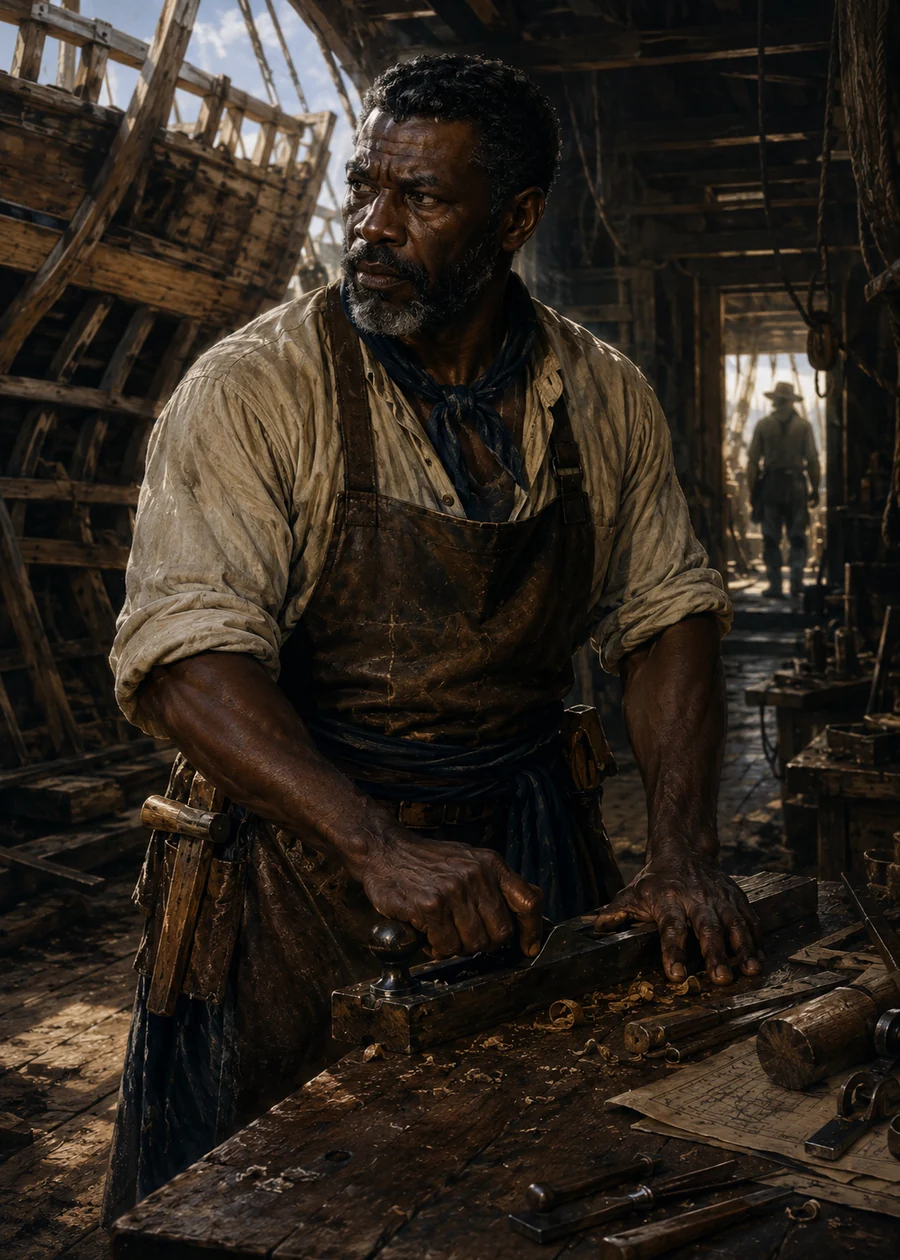
Locked alternate shipwright-workshop portrait: Kobina Teah engaged in precise structural work.
Character Summary
Kobina Teah is a veteran Kru mariner and ship’s carpenter whose grief is expressed through workmanship, discipline, and protection. Quiet, exacting, and physically powerful, he is most legible through what he repairs, what he notices, and what he refuses to let carelessness damage.
Full Biography
Kobina Teah is a forty-six-year-old Kru mariner and the ship’s carpenter aboard SMS Heilige Theodora. He and his twin brother, Kwesi, come from a coastal community in what Europeans presently call Liberia, from a family whose connection to the sea extends across generations. Canoe work, coastal pilotage, shipbuilding, sail handling, interpreting, and contract service aboard foreign vessels were not simply occupations in the Teah household; seamanship was an inheritance and a means of maintaining independence. Kobina went to sea young beside Kwesi and eventually developed his particular mastery through years of repairing coastal craft, replacing storm-damaged timbers, maintaining ship’s boats, working under shipwrights of several national traditions, participating in salvage, and improvising emergency repairs at sea.
The defining tragedy of his adult life is the disappearance of his wife. Both Teah brothers married women from neighboring coastal families, and both women were later taken in a slaving raid or violent seizure connected with an illicit trafficking network that continued despite legal prohibitions. Kobina and Kwesi spent years pursuing reports, spending money and favors in the search, but neither woman was ever conclusively recovered. Kobina refuses to treat his wife as certainly dead. Eventually the brothers took their sons away from the region when remaining there became too dangerous. The exact circumstances of the seizure, the people responsible, and the ultimate fate of either woman remain deliberately unresolved.
Kobina responded to this loss by becoming more controlled, disciplined, and protective. He is quiet, exacting, patient with sincere effort, and deeply intolerant of deliberate carelessness. He rarely needs to raise his voice; among the crew, his becoming quieter is often a stronger warning than shouting would be. He tends to turn emotion into work, and his compassion commonly appears as practical action rather than confession: repairing another person’s belongings, saving food for someone still working, checking Siah’s hands for injuries without comment, or quietly making certain that the people around him have what they need. His humor is dry and sometimes devastating, but it is rarely casual. Praise from Kobina is uncommon enough to carry considerable weight.
Physically, he is about five feet nine inches tall, broad and powerful, with deep-brown weathered skin, close-cropped black hair graying at the temples, dark steady eyes, heavily calloused hands, an old adze scar across one hand, a burn mark along one forearm, and a small notch in one eyebrow. His movements are economical and controlled. At work he favors heavy trousers, a collarless shirt, reinforced waistcoat, sturdy boots, and a tool belt, adding an apron for major carpentry. He owns a formal coat and maintains it carefully despite disliking wearing it.
Aboard Theodora, Kobina is responsible for the physical integrity of the wooden ship. He inspects framing and hull timbers, maintains decks, hatches, bulkheads, ladders and boats, supervises carpenter’s stores and specialized tools, trains his son Siah, and keeps emergency shores, plugs, timber, and damage-control materials ready. When collision, grounding, or serious structural damage occurs, his authority expands naturally with the emergency. He directs shoring and hull repair, decides whether damaged spaces remain safe to occupy, and may sacrifice furniture or fittings when their timber is needed to save the vessel. He does not command navigation, engineering, the deck watch, or combat operations, but even officers are expected to take his structural warnings seriously.
Kobina’s relationship with Siah is loving but demanding. He teaches his son according to the standards of a master craftsman and does not fully understand how intensely Siah wants explicit approval. Kwesi remains Kobina’s closest equal and the one person most able to interpret his silences, although the twins disagree over whether endurance is best expressed through speech or restraint. Kobina is noticeably gentler with young Kofi, while he regards Tamba with affection tempered by concern over the younger man’s appetite for daring. Professionally, he respects Captain Martin because Martin does not disregard the ship’s condition for the sake of pride; he works closely with Roman where engineering and wooden structure meet; he respects Krista as another senior working authority; and he trusts Tāne as a dependable partner during damage control.
Kobina’s supernatural outlook is practical rather than credulous. He believes places, tools, and vessels may accumulate history in ways that people can sometimes feel, but he does not label something magical merely because it is strange. He pays attention when wood behaves contrary to material logic, when the hull produces impossible sounds, when repairs fail without adequate physical explanation, or when objects appear to resist alteration. What would most deeply threaten him, however, is anything that convincingly imitates the voice or presence of his missing wife.
His most personal possessions include a compact tool chest, a measuring rule marked with his own corrections, a sharpening stone, spare spectacles he rarely admits needing, family tokens, a wrapped carving made by his wife, and a small unfinished carving on which he has worked for years. The deeper meaning of some of these objects—and whether any might prove connected to the continuing mystery of the missing women—remains open.
GM CONFIDENTIAL — OPEN HOOKS
The following are deliberately unresolved possibilities or protected questions. They are not automatically settled canon.
- Kobina may possess one credible clue about his wife’s fate that he has never shared.
- He may have killed someone during the failed search.
- He may blame himself for choosing the wrong lead.
- He may fear Siah has inherited his inability to release the past.
- He may believe the family’s continued sea service is both livelihood and search.
- The carved object from his wife may have an unexplained supernatural property.
CANON STATUS
CCD STATUS: CORRECTIVE EDITORIAL REBUILD v1.1 — DRAFT FOR REVIEW. The controlling locked character master/LSPR and the previously locked CCD remain the canon basis. This rebuild creates no new canon. It corrects reference-layer repetition identified during the Ship’s Company CCD audit while preserving the long-form Character Summary / biography in full. Protected-open and Not Established material remain unresolved. Teah-family shared canon remains controlled by its locked shared/group sources where applicable.
Protected-open material remains open. Earlier conflicting summaries and superseded visual studies remain provenance only.
Portrait status: Locked canonical deck/carpenter portrait: Kobina Teah at work aboard SMS Heilige Theodora. Locked alternate shipwright-workshop portrait: Kobina Teah engaged in precise structural work.
Publication provenance
- Publication status: Approved and final for the web archive.
- Visibility: Complete CCD content; no GM/player redaction.
- Source CCD:
Kobina_Teah_CCD.docx - Source SHA-256:
fc4d6e9d2120347b7304f5834dadfd3a19ddd9ed303827392d8cd7d042ef846d - Conversion rule: Presentation and navigation may change; substantive source content is preserved.