Lieutenant Victor Samuel
Master at Arms · Investigator · Engineer’s Mate


“Law is necessary because power without procedure becomes cruelty, but legality alone cannot make an act just.”
Victor Samuel serves aboard SMS Heilige Theodora as Master at Arms: security and weapons officer, investigator, commander of armed expeditionary security, and Engineer's Mate to Roman West. He is a fifty-nine-year-old New Orleans lawman shaped by abolitionism, Reconstruction, corruption, and the belief that lawful power must answer to justice.
He oversees weapons, serious security, prisoners, evidence, and criminal investigation while remaining technically subordinate to Roman in engineering. Martin retains nautical command, Krista ordinary crew discipline, Esme medical authority, and Karl expedition purpose.
Victor is patient, suspicious, observant, guarded, and compassionate beneath a severe exterior. His personal priorities are Esme, Jean, justice, then the ship's cause; this is not the chain of command.
Names and Forms of Address
Victor Samuel is his birth name. “Lieutenant” remains his ordinary professional title; close companions may use Victor or Samuel. Jean normally calls him Victor and may use Lieutenant when teasing. Victor usually calls him Jean, but fear for Jean’s safety may bring out the full “Jean Champollion.”
Age and Appearance
Victor is fifty-nine and six feet tall, lean rather than broad, with unusual toughness and endurance from a lifetime of patrol work, pursuit, violence, and long hours.
His hair is white-gray, his eyes gray-blue, and his complexion pale and weathered. A large old-fashioned mustache and heavy expressive eyebrows are what people notice first.
His body carries knife scars, bullet wounds, old fractures, poorly healed cuts, beating injuries, stiff shoulders, a damaged back, painful knees, and joints worsened by cold or wet weather.
He is not fragile. He is worn. Victor hides pain and accepts help only after the need becomes obvious; standing, sitting, or straightening after long work may reveal what his voice does not.
Clothing
Ordinary Dress
Victor favors practical dark wool coats, durable waistcoats, plain shirts, heavy trousers, sturdy boots, serviceable gloves, and useful pockets. His clothes are clean and functional rather than fashionable.
Formal Dress
His formal clothing is respectable, carefully maintained, and unmistakably old-fashioned. He prefers reliable cuts from his youth and middle age.
Expedition and Security Dress
Ashore or during armed work he dresses for weather, movement, and endurance. Revolver, notebook, pencil, restraints, and evidence materials are tools of office, not display.
Walking Stick and Equipment
Victor usually carries a heavy walking stick for his damaged joints; it is also a familiar defensive weapon and has no hidden mechanism.
Temperament
Victor is patient, suspicious, tough, observant, emotionally guarded, and more compassionate than he first appears.
Suspicion means inquiry, not guilt. He distrusts easy certainty, asks who benefits, separates observation from interpretation, respects courage, and distrusts recklessness.
He is slow to trust and slow to withdraw earned trust. Affection appears as preparation, protection, coffee, remembered injuries, and practical attention.
His seriousness is not humorlessness. Victor has a dry, understated humor and should never become merely a grim interrogator or helpless old man.
Voice and Speech
Victor speaks with an old New Orleans accent shaped by English family origins, street life, French and Creole influence, port communities, and police work. His speech is measured, plain, deliberate, and comfortable with silence.
Common Expressions
- “Begin at the beginning.”
- “Tell me what you saw, not what you think it means.”
- “Those are not the same thing.”
- “Try it again.”
- “I did not ask what you intended.”
- “A man may be foolish without being guilty.”
- “A confession is not proof.”
- “Who benefits?”
- “That answer came too quickly.”
- “You have omitted something.”
- “I believe you believe it.”
- “Justice may yet have a different opinion.”
Emotional Voice
Angry, Victor becomes still; his voice grows quieter, flatter, and more precise.
Frightened, he becomes procedural: identify danger, assign tasks, control access and weapons, keep people alive.
Grieving, he retreats into facts, records, and practical care; private grief comes after names and duties are accounted for.
Suspicion makes his politeness excessive and his brows expressive. Affection softens his voice without making his words less practical.
With Esme he becomes overformal; with Jean, paternal warmth and worry show readily. In command his voice is short and carrying.
Characteristic Gestures and Habits
- Strokes or smooths his mustache while thinking.
- Raises one bristling eyebrow when unconvinced.
- Rubs an old injury in cold or wet weather.
- Turns a short pencil between scarred fingers.
- Checks doors and windows automatically.
- Positions himself where he can see entrances.
- Looks at hands and shoes before faces.
- Tests a chair before lowering stiff joints into it.
- Straightens slowly after prolonged standing.
- Allows silence to remain after an answer and watches how people react to one another. His notebooks, watch, ledgers, and orderly placement of tools are recurring anchors. He often notices fatigue, injury, access, and missing objects before he notices that a conversation was meant to be casual.
Relationships
Esme Rainwater
Victor and Esme share an observable slow, mature courtship built on Jean’s rescue, professional trust, gambling, quiet company, bluff-reading, coffee, practical gifts, and Esme’s care of his injuries. He admires her courage, competence, independence, and medical authority; her private feelings and future choices remain player-controlled.
Jean Champollion
Victor loved Jean as a son before the disappearance. Jean sees him as father, mentor, friend, guardian, and moral compass while remaining an adult scholar with full agency. Victor must protect without controlling; he and Esme increasingly form a chosen-family bond with Jean.
Karl Der Hoch Von Hohenschwangau
Victor respects Karl’s courage and accepts his mission and occult-objective authority without granting moral immunity. As a trusted professional he receives supernatural facts needed for safety, custody, evidence, and mission security, but not automatically Karl’s full bargains or every household secret.
Martin Patrick Duffy
Victor and Martin share a growing friendship grounded in responsibility. Victor values Martin’s loyalty, mercy, refusal to waste lives, and command responsibility, judging him morally stronger than many law-abiding men. Old smuggling is judged by harm, context, evidence, and legitimate authority.
Henri Garnier
Victor respects Henri’s skill, emotional honesty, and calculated risk. Henri reads ports, tides, and routes; Victor reads evidence, access, weapons, and human danger. Victor supports Henri’s lawful nautical succession without competing for command.
Allie
Victor is law-minded; Allie is law-shaped but not consistently law-abiding. He respects Allie’s discipline, records, and loyalty. Allie’s silence is administrative and ancient; Victor’s is investigative. Victor does not automatically know Allie’s complete nature as Tiwaz.
Krista Elsner
Victor trusts Krista on ordinary discipline, labor, exhaustion, deck conduct, and the hands. Krista handles daily correction; Victor takes violent, criminal, conspiratorial, weapon, custody, and direct-security matters. They divide responsibility rather than compete.
Rudi Elsner
Rudi’s galley is one of the few places Victor relaxes. He values Rudi’s disciplined observation of appetite, routine, injury, absence, and mood. Rudi offers romantic advice persistently; Victor resists publicly and formally asks for it only once.
Roman West
Victor serves as Roman’s Engineer’s Mate. Roman, permanent Chief Engineer, has final technical authority; Victor provides disciplined assistance, access control, labor organization, security, and evidence handling. In suspected sabotage Roman determines the mechanical facts while Victor investigates people and responsibility.
Mateo Fernandes de Noronha
Victor respects Mateo’s calm, exact observation, immaculate watch notes, and Indian Ocean judgment. He coordinates security with the officer of the watch and distinguishes translation, cultural explanation, and inference rather than reducing Mateo to an interpreter.
Safire Romanov
Victor’s respect for Safire was earned in New Orleans. He recognizes her courage, covert ability, and contribution against DuPont and Torquemada. She is a voluntary specialist, not his subordinate; her private views and future choices remain player-controlled.
Minty, Belinda, and the Bloomfeld Household
Victor respects Minty’s medical honesty and delegated authority and Belinda’s social intelligence as real expertise. His long Bloomfeld association enabled his work without buying his obedience. The specific Bloomfeld patron represented in his private correspondence remains open.
The Working Company
Victor treats Tāne, Fred, Nobby, the Teahs, Burlycoves, Demirs, and ordinary hands as individuals. Rescue creates no ownership; criminal history does not erase rights; family or group loyalty does not transfer guilt. Specialist authority, informed refusal, humane custody, and truthful record matter.
The Unseen Household
Victor first records supernatural events as security incidents and gradually accepts distinct spirits and forces. Sailor spirits may respond to his preservation of names; kobolds find his locks, labels, and inventories irresistible. Strangeness alone proves neither benevolence nor guilt.
Law, Justice, and Investigation
Victor believes law is necessary because power without procedure becomes cruelty, but legality alone cannot make an act just. Process can protect the powerless, restrain vengeance, preserve evidence, and prevent arbitrary punishment; colonial or political law can also legalize exploitation.
Responsibility requires meaningful choice. Complete possession can remove culpability; partial compulsion requires inquiry into remaining choices, resistance, help sought, and later conduct. Supernatural bargains require attention to consent, knowledge, fraud, and continued benefit.
Spirit testimony requires corroboration. Magical confession is not proof because altered thought, memory, will, or speech destroys reliability. Where memory may be changed, Victor relies more heavily on physical traces, independent timelines, prior documents, and multiple witnesses.
A cursed or sentient object may be evidence, weapon, hazard, prison, witness, or participant. Nature alone is not guilt. Victor distinguishes suspicion from proof, protective custody from punishment, lawful authority from moral legitimacy, and necessary force from revenge.
Moral Boundaries
“A confession is not proof.”
Prisoners are persons entrusted to Victor’s protection. Search, restraint, deception, weapon issue, and force must match real danger. Surrender is honored; lethal force requires immediate grave threat. Victor may break local law to prevent slavery, torture, murder, trafficking, racial terror, supernatural enslavement, or comparable injustice when no lawful remedy exists.
He Will Never
- Torture or authorize torture.
- Manufacture evidence or knowingly destroy exculpatory evidence.
- Execute a helpless prisoner or punish for revenge.
- Threaten uninvolved family members or use Jean or Esme as leverage.
- Treat coerced or magically compelled confession as reliable proof.
- Convict an innocent person merely to preserve order.
- Surrender a prisoner to authorities he knows will torture or murder them.
- Issue weapons or accept custody practices he believes are irresponsibly dangerous or cruel. Victor may refuse a superior within his professional sphere when an order requires cruelty, fabricated evidence, abusive custody, betrayal of surrender, irresponsible weapon issue, or abandonment of someone entrusted to his protection. He states the objection directly and accepts the consequences.
Everyday Flaws
- Suspicious by habit and slow to trust.
- Turns ordinary conversations into interviews.
- Treats secrecy as probable guilt more often than he should.
- Distrusts habitual liars even when they speak truthfully.
- Can overvalue a coherent motive and underestimate institutional crime.
- Struggles with meaningless violence and unresolved questions.
- May resist a supernatural explanation longer than the evidence warrants.
- Becomes personally compromised when Esme or Jean is involved.
- Overprotects Jean and can mistake protection for authority.
- Becomes overformal and awkward with Esme.
- Confuses restraint with emotional honesty.
- Conceals pain and fatigue and refuses help too long.
- Assumes experience makes him the proper person to take risks.
- Carries old cases mentally into new investigations.
- Can become rigid when jurisdiction or authority is uncertain.
- May continue investigating after enough is known to act.
- Can mistake privacy for obstruction.
- May use procedure to delay an emotionally difficult decision.
Crisis Behavior
Suspicious Death
Protect life, secure the scene, restrict movement, separate witnesses, inventory relevant weapons, build a provisional timeline, and prevent accusation from outrunning evidence.
Mutiny or Mass Refusal
Distinguish conspiracy from fear, grievance, drunkenness, panic, a lone offender, legitimate refusal of unsafe orders, or supernatural influence; identify actual organizers and causes.
Boarding or Armed Intrusion
Secure the armory, organize defenders, protect noncombatants and prisoners, control ammunition, and work under Martin’s engagement command; favor clear fields of fire and disciplined withdrawal.
Hostage or Prisoner Crisis
Slow events, establish communication, identify exits and lines of fire, and make no promise he cannot keep. Surrendered or helpless prisoners remain under his protection.
Esme or Jean Endangered
His judgment becomes more aggressive and personally risky. He acts relentlessly, but another trusted officer may need shared oversight when his priorities narrow professional distance.
Roman or Engineering Emergency
Follow Roman’s technical instructions, organize access, tools, rescuers, guards, and evacuation. If Roman is incapacitated, use only established emergency procedures and seek the best technical help.
Corrupt Authorities or Mob Violence
With corrupt officials Victor is courteous, patient, and profoundly uncooperative while recording names, ranks, documents, threats, and contradictions. Against mobs he identifies leaders, protects exits and vulnerable people, and uses command before force.
Supernatural Compulsion
Remove weapons where practical, isolate the affected person, seek Esme or occult expertise, document behavior and timing, and treat the event as both security and medical emergency rather than immediate guilt.
Wrongful Accusation
When accusation aligns neatly with prejudice, reputation, class, race, nationality, criminal history, or supernatural fear, Victor asks who benefits and what independent evidence exists.
His Own Error
If Victor accuses wrongly or makes an investigative error, he admits it publicly and specifically, corrects the record, attempts restitution, and does not hide behind intent or reputation.
Competencies
Investigation and Law Enforcement
- Witness and suspect interviewing without torture.
- Timelines, reports, and exact statement recording.
- Evidence preservation and period crime-scene reconstruction.
- Contradiction detection and confession corroboration.
- Missing-person, homicide, sabotage, corruption, and political-violence cases.
- Informants, witnesses, custody, and outside officials.
- Port, river, customs, smuggling, and jurisdictional experience.
- Court testimony, warrants, procedure, and institutional politics.
Security and Combat
- Threat assessment, guards, protective details, and evacuation.
- Armory control, weapon inventory, ammunition issue, and gun-crew security.
- Arrest, restraint, prisoner escort, search, and crowd control.
- Armed shore parties, boarding defence, rally points, and extraction.
- Competent revolver and long-arm use and maintenance.
- Walking-stick defence, grappling, restraint, knife defence, and close interiors.
Street and Field Skills
- Urban tracking, surveillance, and counter-surveillance.
- Reading neighborhoods, ports, ambush points, and criminal routines.
- Following river and port traffic; working with informants.
- Riding, basic wilderness travel, and map reading.
- Working while injured and organizing frightened people.
- Practical first aid until Esme or Minty takes over.
Engineering, Legal Knowledge, and Languages
- Machinery watches, inspections, routine maintenance, tools, and safety under Roman.
- Recording heat, pressure, sound, vibration, leaks, and other observable changes.
- Municipal law, Reconstruction politics, jurisdiction, customs, corruption, and patronage.
- Fluent English; useful French, Louisiana Creole, and port/street Spanish.
- A few imperfect German or Yiddish-derived family words.
- Strong incident, evidence, prisoner, weapon, and access records.
Practical Limits
Victor is not omniscient, a modern forensic scientist, physician, universal interpreter, occult authority, or replacement Chief Engineer. Age, pain, fatigue, cultural assumptions, incomplete supernatural knowledge, period methods, and personal compromise around Esme and Jean matter.
Signature Possessions
Pocket Notebook and Short Pencil
Contains names, timelines, descriptions, contradictions, port contacts, weapon markings, and personal reminders disguised as case notes. Victor uses pencils almost to their end.
Former Badge or Commission
Old lieutenant’s badge or commission papers, retained because the work mattered; no universal jurisdiction abroad.
Service Revolver
Well-maintained, unornamented service revolver; a tool, not a symbol.
Heavy Walking Stick
Supports damaged joints and doubles as a familiar defensive weapon; no hidden mechanism.
Restraints
Service handcuffs or compact irons, with cord or straps when metal is unsuitable.
Evidence Materials
Envelopes, wraps, labels, string, wax, tins, chalk, measuring cord, and folding rule.
Pocket Watch
Old scratched watch used for timelines; its personal history remains open.
Annotated Legal Code
New Orleans or Louisiana legal volume annotated with cases, abuses, objections, and unjust laws.
Unresolved Case File
One unresolved or failed New Orleans case file; its subject remains open.
Private Correspondence
Established: Jean’s note; an Esme medical card or instruction; one lost-family photograph; and a letter from the Bloomfeld patron who protected him.
Shipboard Incident and Weapons Ledgers
Separate ledgers for incidents and for weapon/ammunition issue, return, condition, and maintenance.
Engineering Work Gear
Gloves, eye protection, oilskin, tool roll, watch notes, and maintenance items stored apart from evidence.
Security Office, Evidence Room, and Cabin
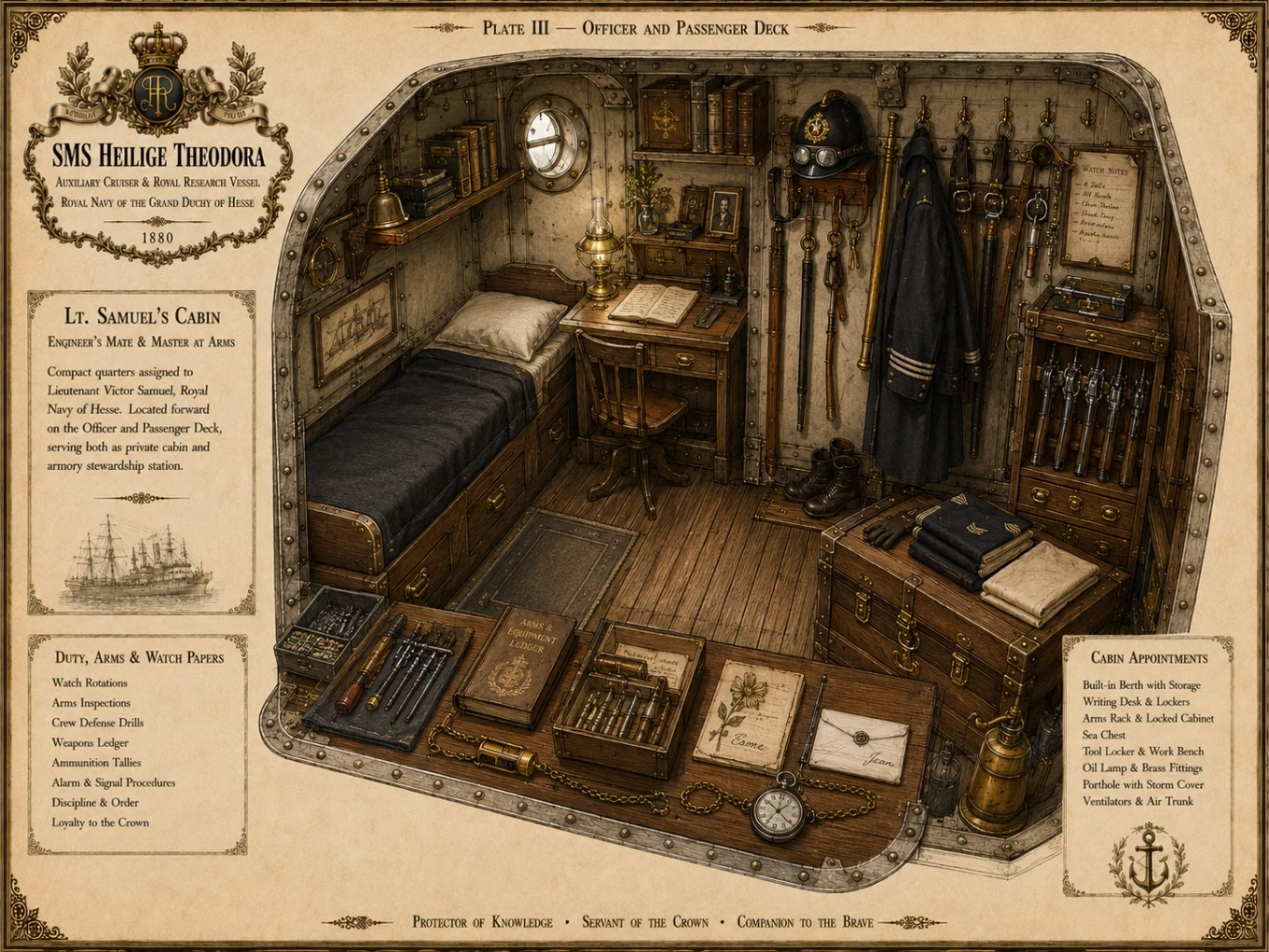
Victor uses a sparse security office, secure evidence storage, and a private cabin on Plate III, Space 26. Order reflects accountability, not intimidation.
Security Office and Evidence Room
- Narrow desk and straight-backed interview chairs.
- Locked evidence cabinet and secure armory access.
- Incident and weapons ledgers, tags, restraints, and measuring tools.
- Wall maps and port/jurisdiction charts for police, courts, customs, consulates, prisons, warehouses, and escape routes.
- Small washstand, oil lamp, coat hooks, and little decoration.
- Engineering-access notes for sabotage, theft, negligence, or unauthorized entry.
- Dangerous or occult objects isolated as evidence pending specialist examination.
- Roman keeps technical machinery logs; Victor records security, custody, access, and witnesses.
Personal Cabin — Space 26
Victor’s cabin is spare and old-fashioned: dark clothing, carefully cleaned weapons, legal books, family papers, liniment, bandages, joint supports, mustache kit, a joint-friendly chair, and small writing desk.
Cabin and Work-Locker Features
- Locked drawer: Jean’s note, Esme’s correspondence, old badge, and one photograph of his lost family.
- Separate work locker: engineering clothes, gloves, eye protection, oilskin, tool roll, notes, and maintenance items.
- Weapons-cleaning materials kept apart from evidence and correspondence.
- Legal books, unresolved case file, and family papers kept ready.
- Liniment, bandages, and joint supports kept within reach.
- A chair chosen for damaged knees and back, not appearance.
- Dark clothing and formal garments maintained with old-fashioned care.
- No trophies from arrests, prisoners, or violence; austere, not punitive. The cabin suggests a man who long expected to leave quickly and has only recently imagined a future.
Additional Canonical Views

Locked alternate portrait: Victor investigates tracks and questions a witness on a wet, foggy Victorian dock. This view emphasizes fieldcraft, persistence, accumulated injuries, and practical investigation beyond the ship.
Character Summary
Lieutenant Victor Samuel is an aging New Orleans lawman shaped by abolition, Reconstruction, street violence, and decades spent resisting injustice from within compromised institutions. His body is scarred and weathered, his joints are failing, and his fashions belong to an earlier generation. His principles have survived. His paternal love for Jean, awkward devotion to Esme, service as Roman’s Engineer’s Mate, and growing friendship with Martin have given him a new life aboard SMS Heilige Theodora. He has lost his family, city, rank, and institution without losing his conviction that truth must serve justice and that justice without mercy can become another form of cruelty.
Full Biography
Lieutenant Victor Samuel is fifty-nine years old, six feet tall, and a native of New Orleans. He is a lean, weathered man whose appearance records nearly four decades of hard service more plainly than any résumé could. His hair has gone fully white and gray, his eyes are gray-blue, and his pale complexion is heavily lined by age, weather, exhaustion, and old pain. A large, old-fashioned mustache and expressive heavy eyebrows dominate his face and have a habit of betraying reactions that the rest of him would prefer to keep private. His body carries knife scars, bullet wounds, old fractures, badly healed cuts, injuries from beatings, a damaged back, stiff shoulders, painful knees, and joints that worsen in cold and wet weather. He is not fragile. He is worn. He has learned to continue working through pain and is far more willing to conceal an injury than to admit that he needs assistance.
Victor dresses much as he has for years: dark wool coats, durable waistcoats, plain shirts, heavy trousers, sturdy boots, gloves, and garments selected more for usefulness than fashion. His formal clothing is respectable, carefully maintained, and unmistakably behind the times. He sees little reason to abandon a reliable cut merely because younger men have decided it is unfashionable. On expedition he favors weather-resistant clothing that allows him to move freely, and he nearly always carries a heavy walking stick. The stick supports his damaged joints, but Victor also knows how to use it as a weapon.
Victor Samuel is his birth name. He descends from an English Jewish family whose active religious life largely ended when his grandfather abandoned the faith after emigrating from England. Victor himself was not raised as an observant Jew and does not present himself as one. Even so, pieces of that inheritance survived in family names, expressions, half-remembered words, stories of exile and persecution, and an ingrained awareness that law and official authority have often been used not merely against criminals but against entire peoples. He is the last surviving member of his immediate family, and the loss of that family is one of several absences he rarely discusses directly.
He entered New Orleans law enforcement as a young man. Experience quickly taught him that the existence of a law and the justice of that law were not the same thing. As he matured, he came to regard slavery not as an unfortunate political institution but as a profound moral evil. During the American Civil War, Victor acted covertly against the Confederacy. His activities included passing information, disrupting communications, interfering with supplies, assisting enslaved people escaping bondage, hiding fugitives, guiding Union sympathizers, and sabotaging Confederate operations in and around New Orleans. Confederate law would have called much of what he did treason, conspiracy, theft, and sabotage. Victor has never accepted that classification in any moral sense. The war fixed in him a conviction that would shape the rest of his life: authority can be lawful and still be wicked.
After the war, he returned to law enforcement during Reconstruction. The work became the defining struggle of his career. Victor deliberately used what authority he possessed to oppose racial assault and murder, voter intimidation, night riders, false arrest, coerced confession, corrupt constables, politically protected killers, and organized terror disguised as public order. He became known as a man who would take a complaint seriously even when powerful people wanted it forgotten. That reputation made him useful to the vulnerable, troublesome to his superiors, dangerous to corrupt men, and increasingly isolated within the institutions he served.
Victor eventually reached the rank of lieutenant and advanced no farther. His abolitionist history, willingness to defend Black victims and witnesses, refusal to alter reports, contempt for political patronage, and habit of investigating men who were accustomed to immunity made higher promotion unlikely. He was too capable to dismiss casually and too inconvenient to reward.
His investigative career ranged far beyond ordinary patrol work. He handled homicide, kidnapping, missing persons, political violence, robbery, fraud, smuggling, corruption, river and port crime, organized intimidation, and incidents that officials preferred to dismiss as accidents. He dealt with municipal police, customs officers, federal marshals, military authorities, private detectives, port officials, consular representatives, riverboat captains, smugglers, informants, political organizers, and criminals of nearly every social class. He learned to watch hands and shoes before faces, to note doors and exits without seeming to look at them, to distinguish a rehearsed story from a confused memory, and to allow silence to continue long enough that people often supplied the detail they had intended to conceal.
Over the years Victor came into the orbit of Horace and Sybil Bloomfeld and their family. Bloomfeld wealth and influence gave him things New Orleans institutions frequently would not: legal protection, access to officials, medical help, support for threatened witnesses, and political insulation from those who wanted inconvenient investigations stopped. Victor never regarded that support as ownership. The Bloomfelds enabled his work; they did not purchase his obedience. His reliance upon wealthy patrons remained a source of discomfort even when their influence was being used honorably.
Through the Bloomfeld family Victor came to know Jean Champollion well before Jean’s disappearance. Their relationship became deeply paternal. Victor was fascinated by Jean’s intellect, scholarship, command of languages and history, adventurous nature, and belief that discovery could improve the world. Jean, in turn, saw in Victor a man whose convictions had survived slavery, war, Reconstruction, corruption, and personal disappointment without becoming cynicism. Victor came to love Jean as a son.
That love has never been simple. Victor wants to know where Jean is going, who is going with him, whether he has slept, whether he is armed, what dangers he expects, and whether he is taking a risk because it is necessary or because guilt has convinced him that his life is expendable. Victor’s instinct is to protect, and one of his recurring failures is allowing protection to become control. He must continually remind himself that Jean is an adult, a scholar, and an expedition professional whose appetite for discovery is not a defect to be cured. Victor has likely made practical provisions for Jean in the event of his own death—money, papers, useful introductions, contacts, and instructions—while insisting that such arrangements are nothing more than sensible planning.
The New Orleans crisis transformed Victor’s life without creating his relationship with Jean. Jean was never merely a suspect whom Victor later came to care for. Their paternal bond already existed before the disappearance.
By the time the crisis erupted, Esme Rainwater had arrived in New Orleans with Karl and their companions. An armed attack surrounding the Bloomfeld clipper Queen Isabella brought their group directly into the Bloomfeld household’s struggle. What followed drew Victor into events far beyond any conventional police investigation: Jean’s disappearance, manuscripts recovered from Brazil and identified as Leonardo da Vinci’s lost journals, Jacques DuPont, Tomás de Torquemada, spectral Inquisitors, supernatural domination, and violent attempts to control both people and knowledge.
During the climactic operations, the allied group divided across several simultaneous fronts. Safire conducted the operation into DuPont’s chambers and vaults. Roman West led Theodora hands and Bloomfeld agents below the Empress du Mond. Elsewhere, Victor and Esme followed smoke into the suites after Jean, while escaping captivity, set fire to a laundry chute and concealed himself in supply rooms. It was Victor and Esme who found him. To get him out safely, they disguised Jean as Esme’s nephew, “Daniel,” and escaped with him.
Victor’s departure from New Orleans was therefore not merely the result of a ruined career. The crisis forced him to acknowledge that the institution to which he had given most of his adult life could no longer contain either the threats he now understood or the people to whom he had become bound. Jean was leaving. Esme had entered his life. DuPont and Torquemada had revealed forms of predation ordinary policing could not confront. The rescued Burlycoves and others needed protection, structure, and the possibility of redemption rather than abandonment. SMS Heilige Theodora offered Victor something he had not expected to find at fifty-nine: a new cause.
He chose to leave New Orleans.
Aboard Theodora, Victor’s formal office is Master at Arms. His duties encompass shipboard security, weapons readiness, armory and ammunition control, serious criminal investigation, evidence custody, prisoners, boarding defense, and the planning and command of armed expeditionary security. He is also Roman West’s Engineer’s Mate. That second role is substantial but carefully bounded. Roman is the ship’s permanent Chief Engineer and retains final technical authority over machinery, engineering spaces, repairs, pressures, shutdowns, and mechanical safety. Victor assists with watches, access control, labor organization, tools, emergency procedures, damage control, evidence preservation, and security within engineering spaces, but he does not pretend to possess Roman’s engineering judgment and does not become Chief Engineer merely because Roman is unavailable.
Victor’s authority likewise exists within a larger web of specialist command. Martin Duffy retains final nautical command and responsibility for the vessel underway. Krista Elsner controls ordinary crew discipline, deck work, rigging, and daily safety among the hands. Esme retains medical authority. Karl determines the expedition’s larger objectives and bears responsibility for its occult purpose. Victor commands within his own sphere, but he believes authority is legitimate only when its boundaries are understood. He will refuse an order that requires cruelty, fabricated or destroyed evidence, abuse of a prisoner, irresponsible weapon issue, punishment without basis, or conduct that repeats the institutional evils he spent his career opposing.
His relationship with Martin has developed into genuine friendship. Victor knows enough of Martin’s past to understand that the captain has been involved in smuggling, though Martin has never given him a complete accounting of every route, cargo, alias, or offense. Victor does not consider the word smuggler sufficient to settle a moral question. He distinguishes between evading taxes, moving medicine or fugitives, trafficking people, supplying oppressors, carrying stolen property, and transporting dangerous occult material. What matters is who was harmed, who benefited, what alternatives existed, and what responsibility remains. He has come to believe that Martin possesses a stronger moral character than many men who have never broken a law.
With Karl, Victor maintains professional respect without surrendering moral independence. He recognizes Karl’s courage, intelligence, strategic responsibility, and unusual knowledge, but neither aristocratic rank nor occult expertise grants immunity from scrutiny. Victor is trusted with supernatural information necessary for security, custody, evidence handling, weapons safety, and immediate operational survival. He is not automatically included in every secret. Karl’s complete bargain history, Allie’s complete nature, and the private occult confidences of other expedition members do not become Victor’s merely because he is responsible for security.
Allie particularly frustrates and interests him. Victor recognizes extraordinary administrative discipline, precision, and competence, while also knowing that Allie withholds information. Their silences are fundamentally different: Victor’s is investigative; Allie’s is administrative and ancient. Victor does not automatically know the full truth of Allie’s identity as Tiwaz. The deeper moral problem Allie presents to him is whether a technically lawful deception can nevertheless remain morally dishonest—or whether, in some circumstances, a technically unlawful lie may be the more just act.
His relationship with Esme has become one of the central facts of his new life. What began as restrained attraction and awkward courtship has developed into a slow, mature romance. Victor admires her courage, competence, independence, medical authority, moral clarity, refusal to be intimidated, and insistence on treating Jean as a person rather than a problem to be managed. Around Esme, the normally measured Victor becomes excessively formal. He researches flowers more carefully than some investigations, offers useful books and medical supplies as though submitting evidence, stands when she enters, chooses compliments with disastrous precision, and can occasionally abandon a sentence when he realizes where it is going. He has sought Jean’s advice about her and, after considerable reluctance, Rudi’s advice exactly once.
Their companionship also has quieter forms: coffee, practical gifts, gambling, shared observation of other people’s bluffs, moments of silence in which neither needs to perform, and Esme’s refusal to tolerate Victor’s habit of disguising injury as inconvenience. Victor can become overprotective when she is in danger, but he accepts her medical authority and would never willingly demand that she abandon her work, conscience, independence, patients, Jean, or place aboard the ship. His love for her is established. Esme’s ultimate choices, commitments, and interpretation of that relationship remain her own.
Victor, Esme, and Jean are gradually becoming an unusual chosen family. Victor and Esme often care for Jean with an almost parental instinct, but the healthiest version of that bond requires both of them to remember that Jean is not a child. Victor’s paternal love is real; so is Jean’s adult agency.
Victor’s broader relationships aboard ship generally follow the same pattern: he respects genuine competence and distrusts authority that cannot explain itself. He works cleanly with Krista because ordinary discipline and serious security are related but distinct responsibilities. He respects Henri Garnier’s skill and emotional honesty even when he considers Henri too willing to embrace risk. He values Mateo Fernandes de Noronha’s exact watch records, navigation, judgment, and cultural knowledge without reducing him to an interpreter. He respects Tāne Raukura’s rescue and rigging expertise and accepts the principle that in a rescue, saving life takes precedence over preserving evidence.
Rudi Elsner’s galley is one of the few places Victor occasionally relaxes. Rudi attempts to soften him with food, stories, hospitality, and romantic advice. Victor resists visibly and responds more than he admits. Minty Bloomfeld earns his respect because her youth does not diminish her medical honesty; when Esme delegates genuine responsibility to Minty, Victor treats that authority seriously. Belinda Bloomfeld’s social intelligence and controlled use of deception interest him because she continually forces him to consider the difference between literal truth and moral honesty. Safire’s knowledge, composure, and conduct during the New Orleans crisis earned his respect, but Victor does not treat occult or covert information as self-authenticating. He wants corroboration wherever corroboration is possible.
Fred and Nobby become visibly nervous when Victor begins asking calm questions. He has learned, however, to distinguish their ordinary evasions and peculiarities from serious deception. He recognizes Fred’s genuine practical competence beneath confusion and treats Nobby’s evasive manner as a reason to ask better questions rather than as proof of guilt. Their loyalty to one another is family, and Victor understands that fact.
The Teah family, the Demir brothers, the Burlycoves, and the ordinary hands receive the same basic moral treatment from him. Group identity is never enough to determine individual guilt. Rescue creates no ownership. Protection creates no permanent debt. Criminal history does not abolish the possibility of redemption. A prisoner is not merely someone Victor has restrained but a person temporarily entrusted to his protection.
That belief sits at the center of his philosophy. Victor believes law is necessary because power without procedure becomes cruelty, but legality alone cannot make an act just. Law can preserve evidence, restrain vengeance, protect the accused, and prevent arbitrary punishment. It can also defend slavery, racial terror, exploitation, corruption, and social privilege. He therefore asks not only what the law says, but who wrote it, whom it protects, whom it permits to be harmed, and whether enforcing it would produce justice or merely obedience.
His investigative maxim is equally simple: a confession is not proof. A frightened, beaten, drugged, enchanted, exhausted, manipulated, or magically compelled person can say almost anything. Confessions require corroboration. Spirit testimony requires corroboration. Memory altered by supernatural means makes independent physical evidence more important, not less. A cursed object may be evidence, weapon, hazard, prison, witness, or participant. A person acting under complete supernatural possession is not morally responsible for choices that were not theirs. Under partial compulsion, Victor asks what choices remained and whether the victim attempted to resist or seek help. Responsibility requires meaningful choice.
He will not torture. He will not manufacture evidence. He will not punish for revenge, threaten uninvolved family members, knowingly surrender a prisoner to torture or murder, ignore exculpatory evidence, or execute a helpless captive. He may deceive a dangerous suspect, conceal a victim or witness from corrupt authorities, break an unjust law, or temporarily hide evidence from those who would misuse it, but only when doing so serves protection or justice rather than convenience or loyalty.
When violence becomes necessary, Victor uses the same principles. Force must answer an actual threat and remain proportionate to it. Lethal force is justified only by immediate grave danger. Surrender is to be honored. Escape alone does not justify killing a prisoner unless that escape itself creates an imminent threat of death or catastrophe.
Victor is patient, suspicious, observant, emotionally guarded, compassionate, and capable of dry humor. His suspicion is an investigative habit rather than a declaration of guilt. He rarely raises his voice. Anger makes him quieter and more still. Fear makes him procedural: he assigns tasks, checks exits, identifies authority, secures weapons, and begins recording facts. Grief makes him practical. He tends to the living, writes down the names of the dead, completes what must be done, and suffers privately afterward.
His common phrases have become familiar aboard ship: “Begin at the beginning.” “Tell me what you saw, not what you think it means.” “Those are not the same thing.” “A man may be foolish without being guilty.” “A confession is not proof.” “Who benefits?” “You have omitted something.” “The law says many things.” “Justice may yet have a different opinion.”
His habits are equally recognizable. He smooths his mustache while thinking, turns a short pencil between scarred fingers, checks doors and windows without seeming to, watches how people respond to one another, tests a chair before lowering stiff joints into it, and allows silence to remain after an answer. His pockets, desk, and office accumulate notebooks, sealed statements, evidence materials, weapon records, maps, jurisdiction notes, and almost-finished pencils. The kobold-like spirits of Theodora appear to find his locks, labels, and inventories particularly fascinating, while lingering sailor spirits may respond to his insistence on preserving names and recording the dead accurately. Victor initially treated such phenomena as security incidents. He has gradually learned that the impossible does not become less real merely because he dislikes its evidentiary habits.
His security office is spare and practical, with a narrow desk, straight-backed chairs, a locked evidence cabinet, incident and weapons ledgers, maps, restraints, tags, measuring tools, a small washstand, and little decoration. His personal cabin is similarly restrained: old-fashioned clothing, carefully cleaned weapons, legal books, family papers, liniment and bandages, joint supports, grooming tools, a chair chosen for comfort rather than appearance, and a writing desk. In a locked drawer he keeps his old lieutenant’s badge, a note from Jean, correspondence from Esme, and a single photograph of his lost family. A separate engineering locker contains work clothes, heavy gloves, eye protection, an oilskin, a tool roll, and the practical items Roman expects his mate to keep ready.
Among Victor’s personal possessions are his former lieutenant’s badge or commission papers, a well-maintained service revolver, restraints, his heavy walking stick, evidence envelopes and labels, an old scratched pocket watch, an annotated volume of Louisiana law, an unresolved New Orleans case file, personal correspondence, and the shipboard incident and weapons ledgers entrusted to him. None is ornamental. Nearly everything he owns either records a duty, performs a task, or remembers someone.
Victor’s greatest flaws are extensions of his virtues. Suspicion can become mistrust. Persistence can become refusal to stop. Procedure can become a way to postpone an emotionally difficult decision. Experience can become self-righteousness. Protectiveness can become control. He conceals pain, refuses help, assumes he should be the one taking the dangerous position, and sometimes expects younger people to recognize dangers he has never actually explained to them. He can continue treating every port as though his jurisdiction somehow followed him there, even though his old New Orleans badge now carries history rather than legal authority.
He also knows, increasingly, that his life is no longer simply the remains of a career.
If his deepest loyalties were ever forced into irreconcilable conflict, Victor’s personal priorities are settled: Esme first, then Jean, then justice, then the ship’s cause. That hierarchy does not replace the chain of command or excuse wrongdoing. It is simply the truth of where his heart would pull him when all clean answers had failed.
Lieutenant Victor Samuel is an aging New Orleans lawman shaped by abolition, Reconstruction, street violence, loss, and decades spent resisting injustice from within compromised institutions. His body is scarred and weathered, his joints are failing, and his fashions belong to an earlier generation. His principles have survived.
His paternal love for Jean, mature devotion to Esme, service beside Roman, friendship with Martin, responsibility for the people aboard Theodora, and encounter with a supernatural world that refuses to fit neatly inside any statute book have given him a life he did not expect to possess. He has lost family, city, rank, and institution without losing his conviction that truth must serve justice—and that justice without mercy can become another form of cruelty.
GM CONFIDENTIAL — OPEN HOOKS
These possibilities remain unresolved and cannot contradict Victor’s fixed priorities, New Orleans chronology, authority, family bonds, moral doctrine, or player-character agency.
- The precise identities and fates of Victor’s immediate family.
- Why his grandfather abandoned Judaism; whether a Jewish family object, record, letter, prayer book, or surviving branch remains.
- The full extent of Victor’s Civil War sabotage and any larger clandestine network.
- Whether Confederates identified him; whether an operation caused death or suffering; whether an ally believes he betrayed them.
- The case that most defined his career and whether it involved a wrongful conviction.
- A witness he failed to protect; a criminal he respected; a solved case never prosecuted.
- An old partner, corrupt superior, or earlier concealment or destruction of evidence.
- The exact subject of the unresolved New Orleans case file.
- Whether his departure was resignation, disappearance, desertion, or flight, and whether his badge or commission was revoked.
- Any active warrant or accusation; officials who would help or arrest him; continuing Bloomfeld protection; DuPont or Torquemada pursuit.
- An unrevealed confession; someone he believes dead who may live; someone seeking revenge.
- His exact provision for Jean; how much Esme knows of his decline; the history of his watch and family papers.
- Whether an old case involved an unrecognized spirit and whether it followed him.
- The unseen household’s full opinion; whether an entity remembers Victor or his family; occult significance of an inherited object.
- Whether law, oath, and witness draw deeper recognition from Allie; the identity of the specific Bloomfeld patron in his correspondence.
CANON STATUS
Canon basis: Lieutenant Victor Samuel — Complete Canon Reference v2.2 — Zero-Loss Standardized Locked Master; LSPR v2.0 controls reconciliation. This CCD is derivative and creates no new canon.
Controlling corrections: Victor is Master at Arms; Roman is permanent Chief Engineer; Esme and Victor found Jean and escaped with him as Daniel; Victor loved Jean beforehand; his priorities are Esme, Jean, justice, ship; his present slow romance with Esme remains ultimately player-controlled.
Portrait status: security-office dossier portrait — primary, locked; dockside-investigation portrait — alternate, locked. This CCD asserts no separate locked cabin vignette.
Publication provenance
- Publication status: Approved and final for the web archive.
- Visibility: Complete CCD content; no GM/player redaction.
- Source CCD:
Lieutenant_Victor_Samuel_CCD.docx - Source SHA-256:
ea9797ffe6d44c976c0fb74e37c2def01629110fa61f4a3b541aeced7da209c4 - Conversion rule: Presentation and navigation may change; substantive source content is preserved.